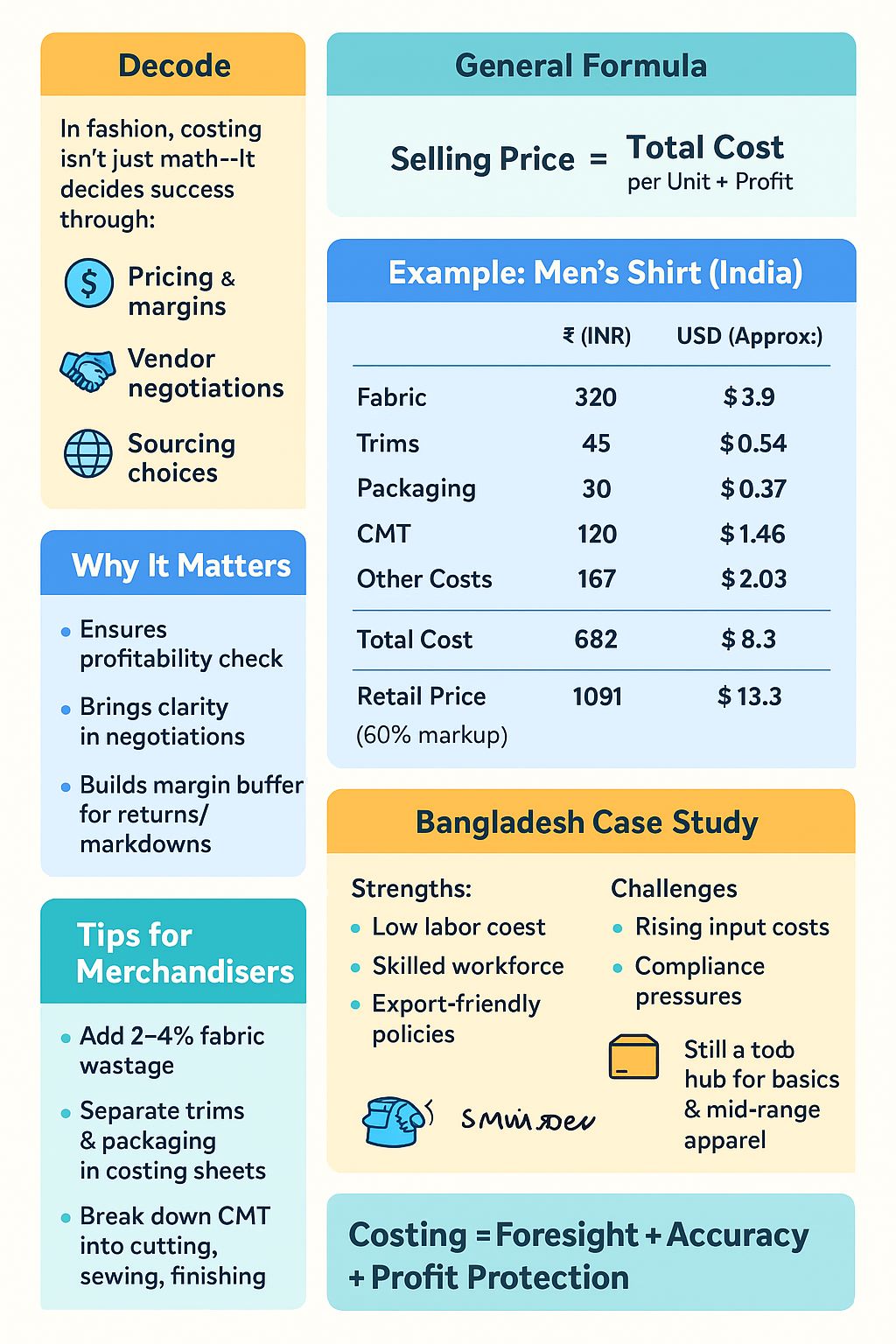
Apparel Costing – The Backbone of Fashion Retail
Decode
In fashion, costing isn’t just math—it decides:
Pricing & margins
Vendor negotiations
Sourcing choices
General Formula
Selling Price = Total Cost/Unit + Profit.
Example: Men’s Shirt (India).
Apparel Costing – The Backbone of Fashion Retail
Decode
In fashion, costing isn’t just math—it decides:
Pricing & margins
Vendor negotiations
Sourcing choices
General Formula
Selling Price = Total Cost/Unit + Profit.
Example: Men’s Shirt (India).

India’s textile & apparel sector at critical crossroad | EY India Partner Prashant Raizada.
India’s pivotal textile and apparel sector stands at a critical crossroad. While the landmark GST reforms will yield long-term structural gains, the immediate external risk in the form of the 50% US tariff on Indian goods remains a critical area of concern.
Such is the view expressed by EY India Partner – Indirect Tax & Incentives, Shri Prashant Raizada. Raizada was addressing a webinar on GST 2.0 & US tariff and their twin impact on the Indian textile and apparel sector jointly organized by the Confederation of Indian Textile Industry (CITI) and EY India on September 26. To help the textile and apparel sector, the GST changes announced on September 3 have eliminated duty inversion to ease cash flow and working capital.
India’s pivotal textile and apparel sector stands at a critical crossroad. While the landmark GST reforms will yield long-term structural gains, the immediate external risk in the form of the 50% US tariff on Indian goods remains a critical area of concern.
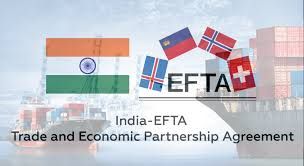
CTA Apparels applauds the launch of the India–EFTA Trade and Economic Partnership Agreement (TEPA), which will come into force on October 1, 2025. As India’s first trade agreement with a European bloc, this milestone represents a significant advancement in deepening economic integration with Europe.
The agreement provides for substantial tariff reductions, duty-free access on 99% of goods, and a commitment of $100 billion in investments from EFTA nations over the next 15 years. This is expected to generate 1 million direct jobs in India, setting a new benchmark by linking market access with long-term investment.
The global apparel trade & retail update report for September 2025.
It provides an overview of the latest apparel consumption and trade data for major supplier and buyer nations.
The key highlights are as follows:
Apparel Imports in July 2025:
US: US$ 7.7 bn, down -3% YoY
EU: US$ 9.6 bn, up 19% YoY
Japan: US$ 2.0 bn, up 5% YoY
UK: US$ 2.1 bn, up 24% YoY.
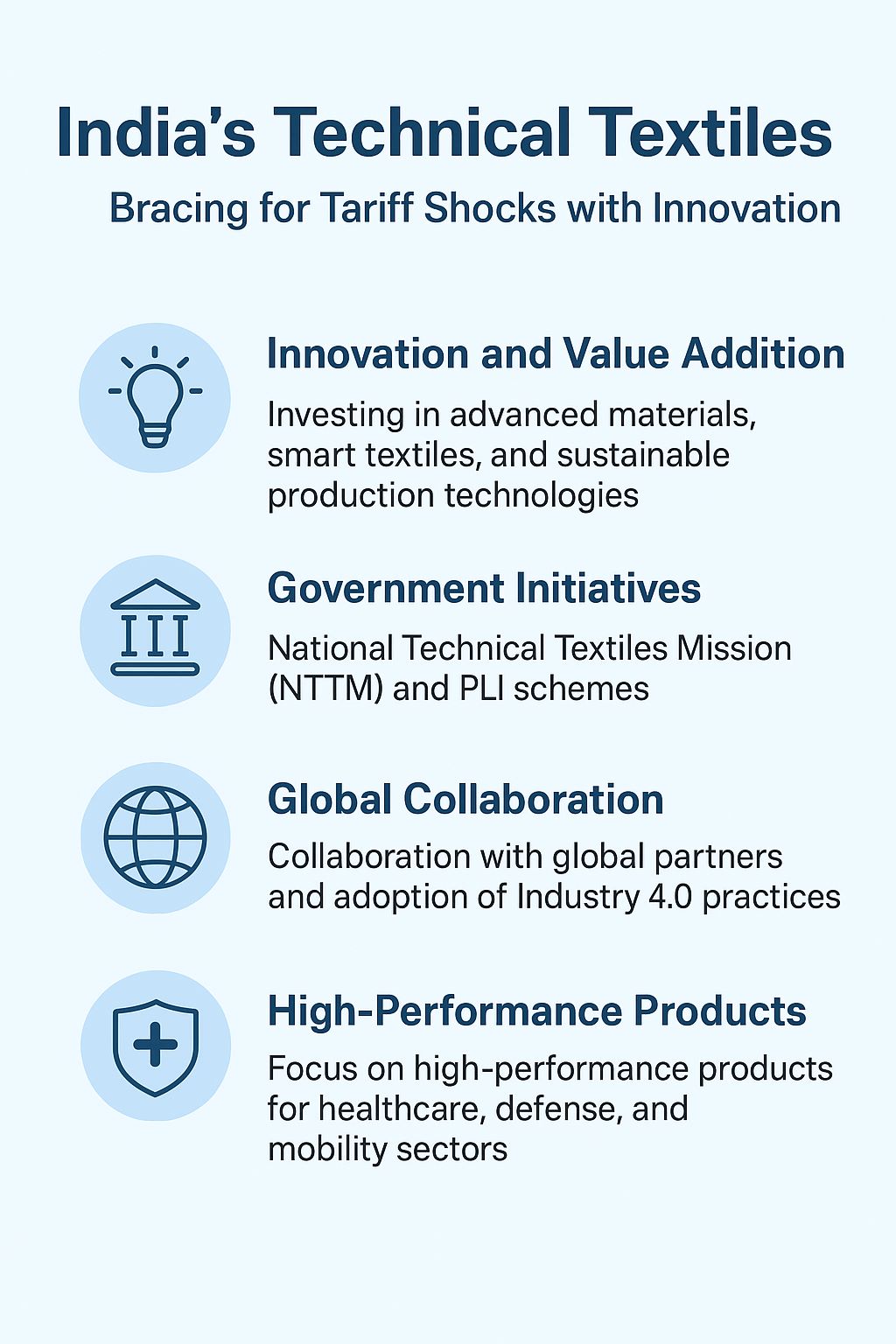
India’s Technical Textiles: Bracing for Tariff Shocks with Innovation.
India’s technical textiles sector, a key pillar of modern manufacturing, is confronting fresh challenges as global trade dynamics shift and tariff barriers rise.
Yet, the industry is positioning itself to counter these shocks through innovation, value addition, and diversification. Companies are investing in advanced materials, smart textiles, and sustainable production technologies to stay competitive in global markets. Government initiatives like the National Technical Textiles Mission (NTTM) and PLI schemes are encouraging R&D and boosting domestic capabilities, reducing import dependence.
Showroom B2B: Scaling with Vision, Depth, and Discipline
In a candid conversation with Salil Chawla, Director, DFU Publications, Sandeep Tewari - 3Fate Technologies Pvt. Ltd. shared how Showroom B2B, backed by Jungle Ventures and other investors, is building a strong growth story on the back of visionary leadership, operational depth, and financial discipline.
Having started as a lean startup, the company is now in its Series A round, closing funding at nearly twice its current turnover—a testament to investor confidence in its scalable business model.
Unlike competitors acting as buying houses, Showroom B2B sees itself as a factory with vertical integration, going upstream from yarn to garment, cutting costs, boosting margins, and ensuring price competitiveness even against global players.
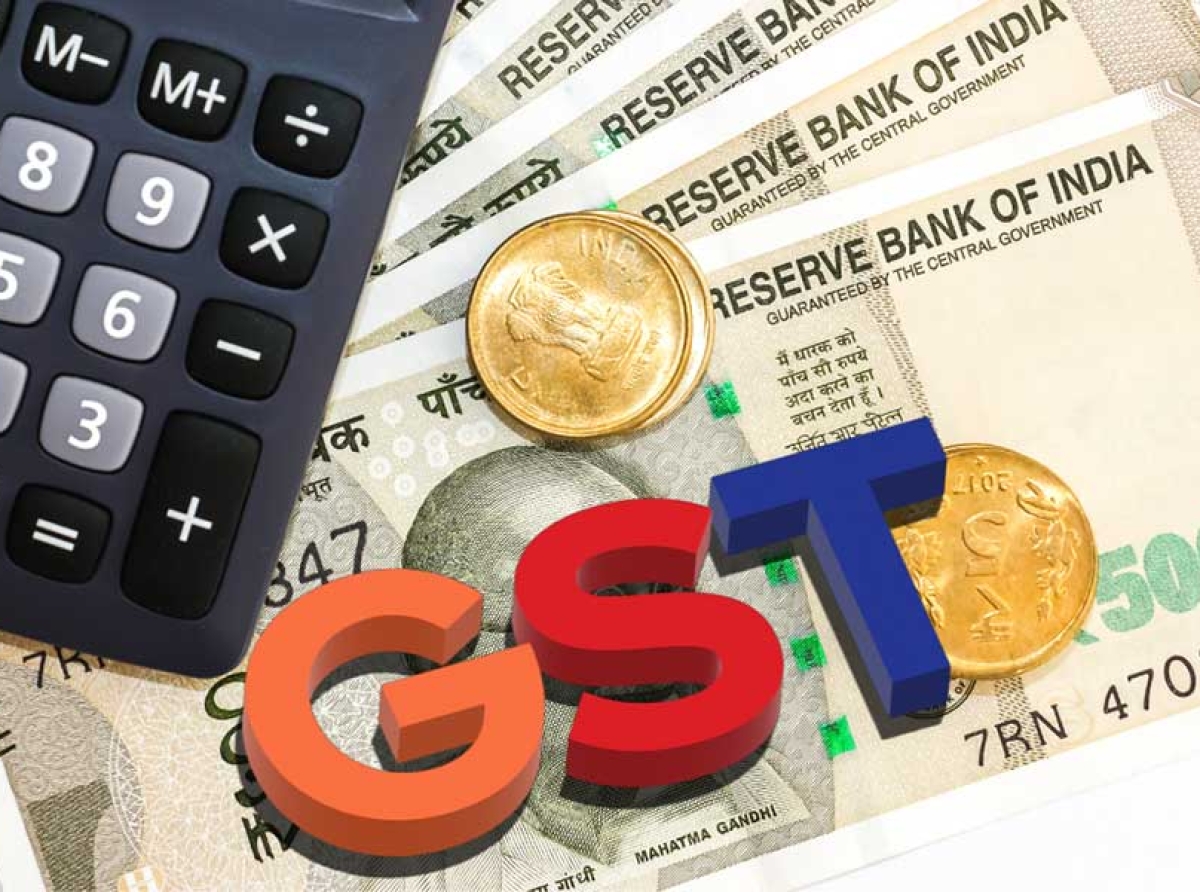
Game-Changer for Textiles! GST 2.0 is here
India’s Textile Sector (USD 179 Bn → Target 350 Bn by 2030) gets a massive push with GST 2.0 effective 22 Sept 2025.
Key Benefits:
5% GST on MMF, yarn & fabrics (earlier 12–18%) → Cost relief
Garments up to ₹2,500 @ 5% (earlier only ₹1,000) → Covers 70% of demand
Made-ups, carpets, handlooms @ 5% (down from 12%) → Export & artisan push
Logistics GST 18% (down from 28%) → Cheaper supply chain.

U.S. Polo Assn., the official sports brand of the United States Polo Association (USPA), proudly supported the XV Federation of International Polo (FIP) European Polo Championship, held from August 26 to September 7 at the prestigious Sowiniec Polo Club in Mosina, Poland. The sports brand served for the fifth time as the Official Apparel Partner of this prestigious event, which is played every two years.
U.S. Polo Assn. outfitted players and umpires in custom-designed performance jerseys and branded caps, alongside field signage and branded on-site activations for event attendees, bringing the brand's authenticity and sport-inspired style to the tournament. The sports brand is the Official Apparel Partner of FIP, which the International Olympic Committee recognizes to host international polo competitions.
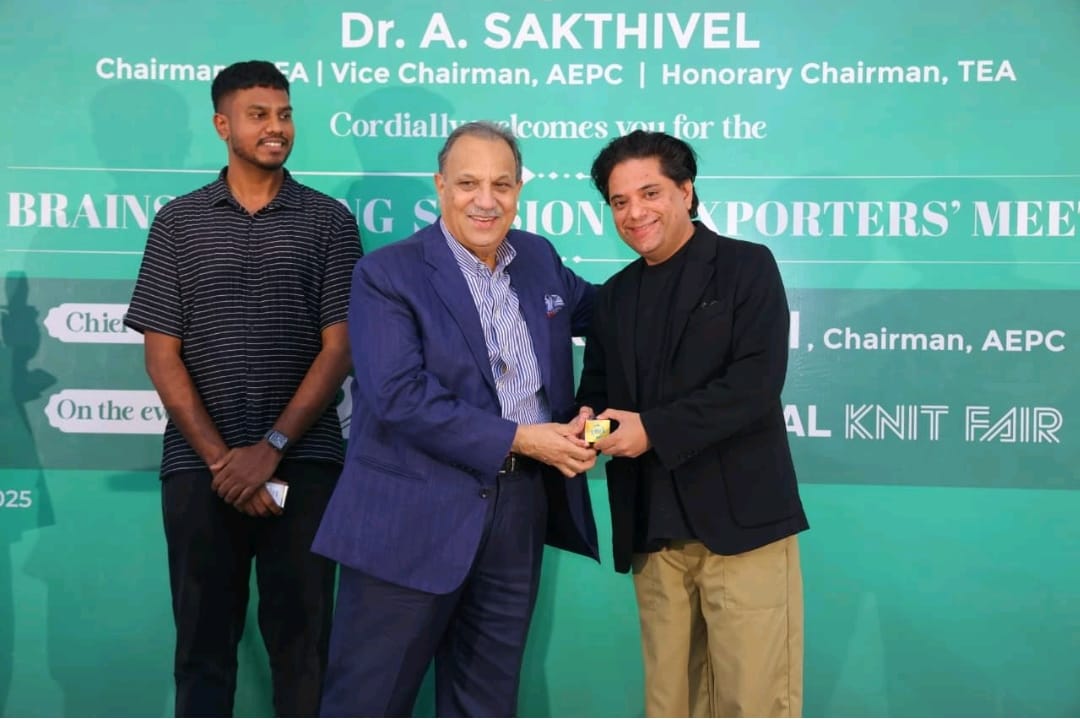
The 52nd India International Knit Fair witnessed a truly insightful Brainstorming Session. The discussions covered relevant topics such as Tirupur 2.0-MMF Making Progress', 'Pivoting Business while Building Resilience', "Innovation & Al-How to Move Forward. etc
Sudhir Sekhri, Chairman AEPC, Dr A Sakthivel, Vice-Chairman AEPC and Shri Premal udani, Chairman Export Promotion AEPC participated in the roundtable session and shared their insights
AEPC, IKFA, and TEA remain committed to driving innovation, resilience, and growth in the apparel sector. The sessions saw actively participated in by exhibitors, buying agents, and industry stakeholders, making it a memorable and meaningful event.
CREDITS: Directly taken from IKF linkedin in and has not been edited and reviewed by us.
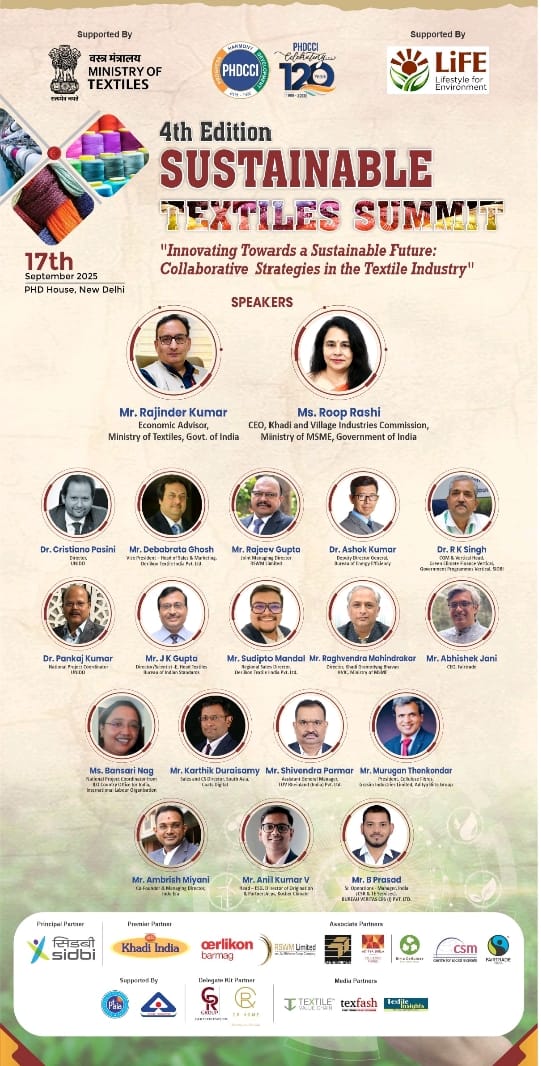
Entrepreneurship, Rural Development & Khadi Transformation.
Brief Overview: KVIC
At KVIC, we firmly believe in the principle: “Don’t just seek a job—become a job creator.” Our Entrepreneurship Generation Program aims to empower individuals, particularly youth and women, to launch their own enterprises.
The PMEGP Program is a powerful enabler in this direction. It provides up to 35% subsidy on projects worth up to ₹50 lakhs, with more than 350 government schemes available for employment generation.
Yet, awareness remains low. At KBIC alone, we have 40–50 such schemes—benefitting 70% rural and 30% urban populations.
.jpg)
Prime Minister Narendra Modi will lay the foundation stone for the country's first Pradhan Mantri Mega Integrated Textile Region and Apparel (PM MITRA) Park in MP's Dhar district on Wednesday. This visit marks Modi's second trip to the state on his birthday, a day he commemorated in 2022 by releasing eight cheetahs from Namibia in the Kuno National Park.PM Modi is scheduled to land in Indore in a special aircraft on Wednesday and will then proceed to Dhar by helicopter to attend the foundation laying ceremony scheduled around noon. Modi will also launch the ‘Swasth Nari Sashakt Parivar' and the ‘8th Rashtriya Poshan Maah' campaigns, aimed at enhancing women's health services and promoting nutrition.
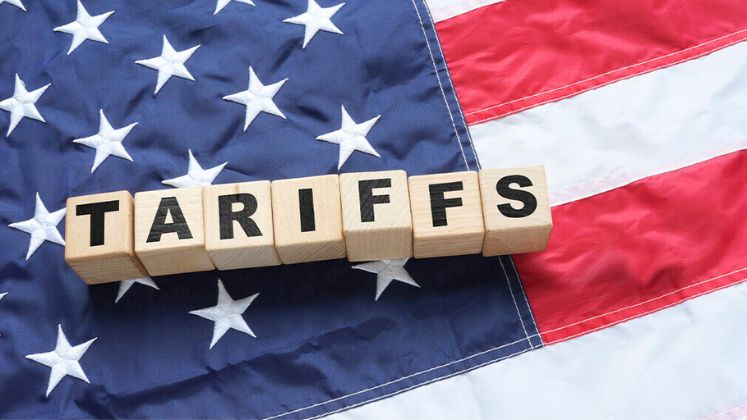
According to a recent KPMG analysis, the prospect of higher U.S. tariffs could dampen trade volumes, slow hiring activity, and weaken investor confidence in India. The report highlights that micro, small, and medium enterprises (MSMEs)—which account for more than 45% of India’s exports—face heightened risks due to their limited customer base and vulnerable supply chains.
With over 30% of India’s exports in sectors such as textiles, pharmaceuticals, smartphones, gems, and marine products heading to the U.S., any tariff hikes could significantly impact competitiveness. In particular, India’s textile exports risk losing market share as other countries benefit from lower duties and cost advantages in the American market.

Shenzhen International Brand Underwear Expo 2026
The Shenzhen International Brand Underwear Expo is set to take place from March 25–27, 2026 at the Shenzhen Convention and Exhibition Center. This flagship event will spotlight the entire spectrum of the intimate apparel industry—from lingerie, shapewear, and active undergarments to maternity and men’s innerwear, sleepwear, loungewear, and accessories.
Organized with the support of national and regional industry associations, the expo serves as a global platform for:
Brand promotion and product launches
Trade collaborations and business networking
Design innovation and industry knowledge-sharing.

THE INS & OUTS OF INTIMATES AND SWIMWEAR: EXPERT ROUNDTABLE
Event timings: 9:00am PST / 12:00pm EST / 6:00pm CEST
Shopper preferences for intimates & swimwear have transformed in the last twenty years, yet many of the tools we use to design and fit these garments haven’t kept pace. Developing garments for both men and women present unique challenges, and the question remains: how can the right tools work together better to help us get it right?
In this live session, experts from Brooks Running, TekGurl/GarmentCreation by Sus, and Alvanon will unpack the future of this technically demanding category.
You’ll learn how evolving consumer preferences are reshaping product development and why specialized tools are essential for getting it right.

The South India Garments Association (SIGA) has urged the Union Government to reconsider the hike in Goods and Services Tax (GST) on garments warning that the increase from 12% to 18% will severely impact middle-class families and the apparel sector.
In a memorandum to Prime Minister Narendra Modi, SIGA president Anurag Singhla welcomed GST reforms but expressed "deep concern' over the sharp jump in rates. He pointed out the disparity between garments priced below Rs. 2,500, which attract 5% GST, and those above Rs.2,500, taxed at 18%. "This 13% gap directly burdens the common man.
Highlighting the industry's significance as one of India's largest employment generators, Singhla noted that the sector provides livelihoods to millions, especially women and rural workers.


 CONTACT US

