









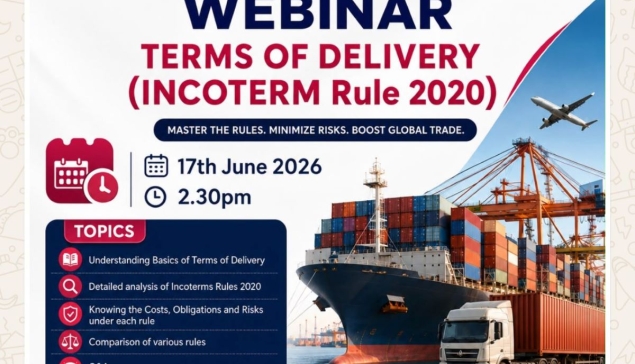






(Incoterm Rule 2020): It is going to be unravelling
This report summarizes the educational material on Incoterms® 2010 and 2020 presented by Sudhakar Kasture (Director, EMI Exim Institute) for The Cotton Textiles Export Promotion Council (TEXPROCIL). The document provides practical mathematical formulas for trade term computations and highlights six structural revisions introduced in the 2020 edition.
Practical Computation of IncotermsThe text defines how different terms are calculated by adding Origin Charges (O/C), Freight (FRT), and Insurance (INS) to base values: FOB, FCA, and FAS are computed as $\text{EXW} + \text{O/C}$. CFR equals $\text{EXW} + \text{O/C} + \text{FRT}$ or $\text{FOB} + \text{FRT}$. CIF equals $\text{EXW} + \text{O/C} + \text{INS} + \text{FRT}$ or $\text{FOB} + \text{INS} + \text{FRT}$. CPT is calculated as $\text{FCA} + \text{FRT}$. CIP is calculated as $\text{FCA} + \text{INS} + \text{FRT}$. DPU, DAP, and DDP are computed as $\text{FOB} + \text{FRT} + \text{O/C}$ for sea transport, or $\text{FCA} + \text{FRT} + \text{O/C}$ for air transport.
Also refer
Key Revisions in Incoterms® 2020FCA Rule Amendment: Revised to allow parties to agree that the buyer will instruct the carrier to issue an on-board bill of lading to the seller after loading, accommodating specific bank and maritime financing demands. Consolidated Cost Listings: All relevant transaction costs are now centralized within article A9/B9 of each rule for immediate visibility, though they remain present in individual descriptive articles. Insurance Level Differentiation: For maritime commodity trading under CIF, the default remains the lower-tier Institute Cargo Clauses (C).
Know More
However, CIP now strictly requires maximum coverage under Institute Cargo Clauses (A). Private Transport Allowance: The updated rules formally recognize that a seller or buyer may utilize their own transport fleet instead of employing a third-party carrier.
Security Requirements: Clearer security-related obligations have been integrated into articles A4 (carriage) and A7 (import/export clearance), with related expenses tracked in article A9/B9. DAT Renamed to DPU: Delivered at Terminal (DAT) became Delivered at Place Unloaded (DPU) to clarify that destination points extend beyond standard terminals. Under DPU, the seller is explicitly responsible for unloading the goods, whereas under DAP, the seller does not unload them.
Credits: Source- Post-event Information PPT received from Ramitha Shetty <



 CONTACT US
