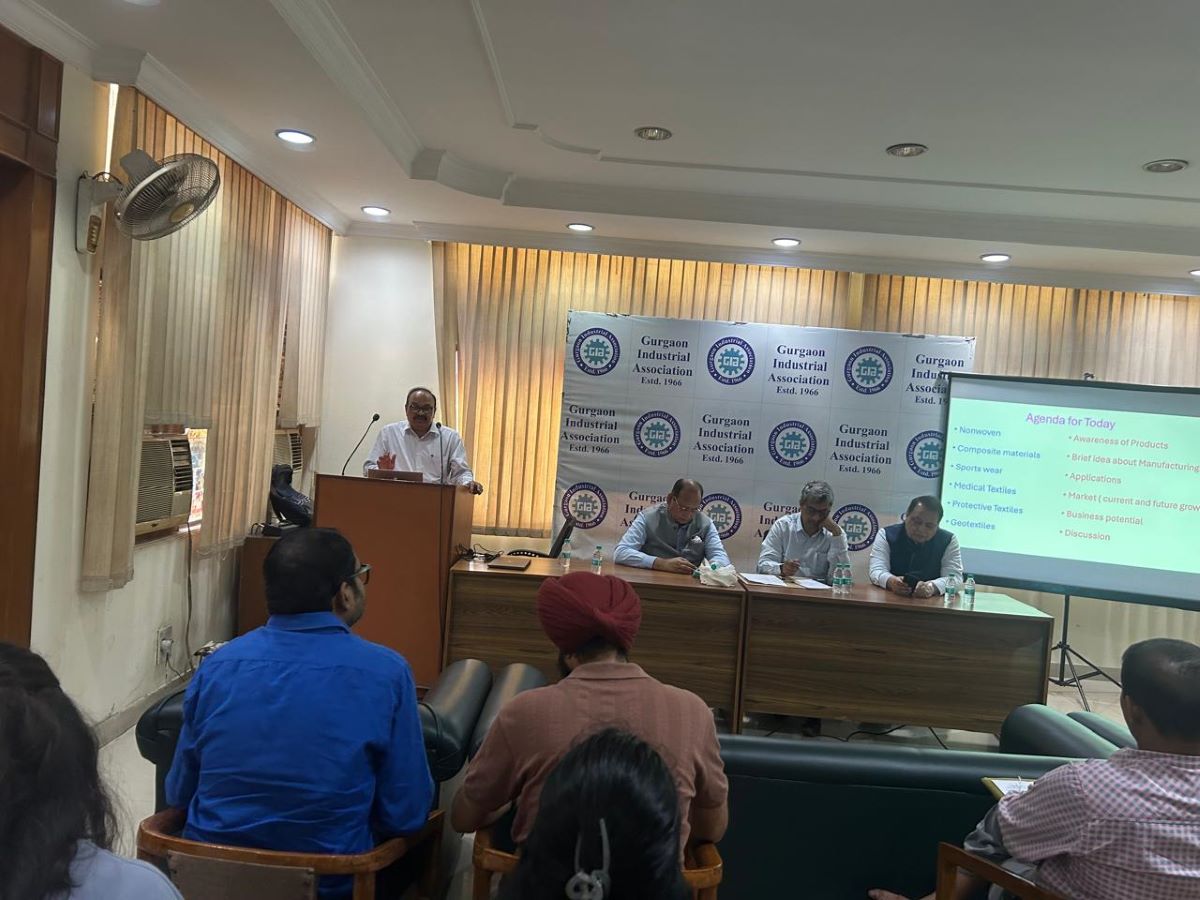
Prof.(Dr)-B.K. Behera, Director TIT & S Bhiwani who comes with vast experience (His area of specialization includes Fabric manufacturing, 3D weaving, Textile Structural Composites, Mechanics of Textile Structure and Project Management.) addressing today at “Technical Textiles Awareness Program” Organized by The Technological Institute of Textile & Sciences Bhiwani-Under the Aegis of ‘Directorate of Micro, Small and Medium Enterprises, Government of Haryana’ emphasized categorically that, one of the most important principles in materials science is that the properties of a material can be significantly enhanced through reinforcement. A simple material may possess certain desirable characteristics, but when combined with a reinforcing component, it can become substantially stronger, lighter, and more durable. This principle forms the basis of composite materials.
A common example is reinforced concrete. Concrete by itself is strong in compression but relatively weak in tension. By embedding steel reinforcement bars within the concrete, the resulting composite material combines the compressive strength of concrete with the tensile strength of steel, creating a structure that is far stronger and more reliable than either material alone.
The same concept is widely applied in advanced materials engineering. Plastics, for instance, are versatile materials derived primarily from petrochemical feedstocks. While plastics offer advantages such as low weight, ease of processing, and corrosion resistance, their mechanical strength may be limited for certain applications. To overcome this limitation, reinforcing materials such as glass fibres, carbon fibres, or natural fibres are incorporated into the plastic matrix.
The resulting materials, known as fibre-reinforced composites, exhibit superior strength-to-weight ratios, enhanced durability, improved stiffness, and better resistance to wear and environmental degradation. These characteristics make them suitable for a wide range of applications, including automobiles, aerospace components, construction materials, sports equipment, and consumer products.
An important advantage of composite technology is its flexibility. Engineers can tailor material properties by selecting specific reinforcement materials and matrix combinations to meet the performance requirements of a particular application. Depending on the design objective, composites can be engineered for higher strength, lower weight, improved impact resistance, or greater thermal stability.
Sustainability is also becoming an important aspect of composite development. Increasing efforts are being made to incorporate recycled plastics and renewable natural fibres into composite materials, thereby reducing dependence on virgin raw materials and supporting circular economy objectives. Recycled plastic composites are increasingly being used in infrastructure, furniture, packaging, automotive components, and construction applications.
In essence, composite materials demonstrate how the strategic combination of two or more materials can produce performance characteristics that exceed those of the individual constituents. By reinforcing a base material with fibres or other strengthening elements, industries can create lightweight, durable, and high-performance products that meet the evolving demands of modern engineering and manufacturing.



 CONTACT US
