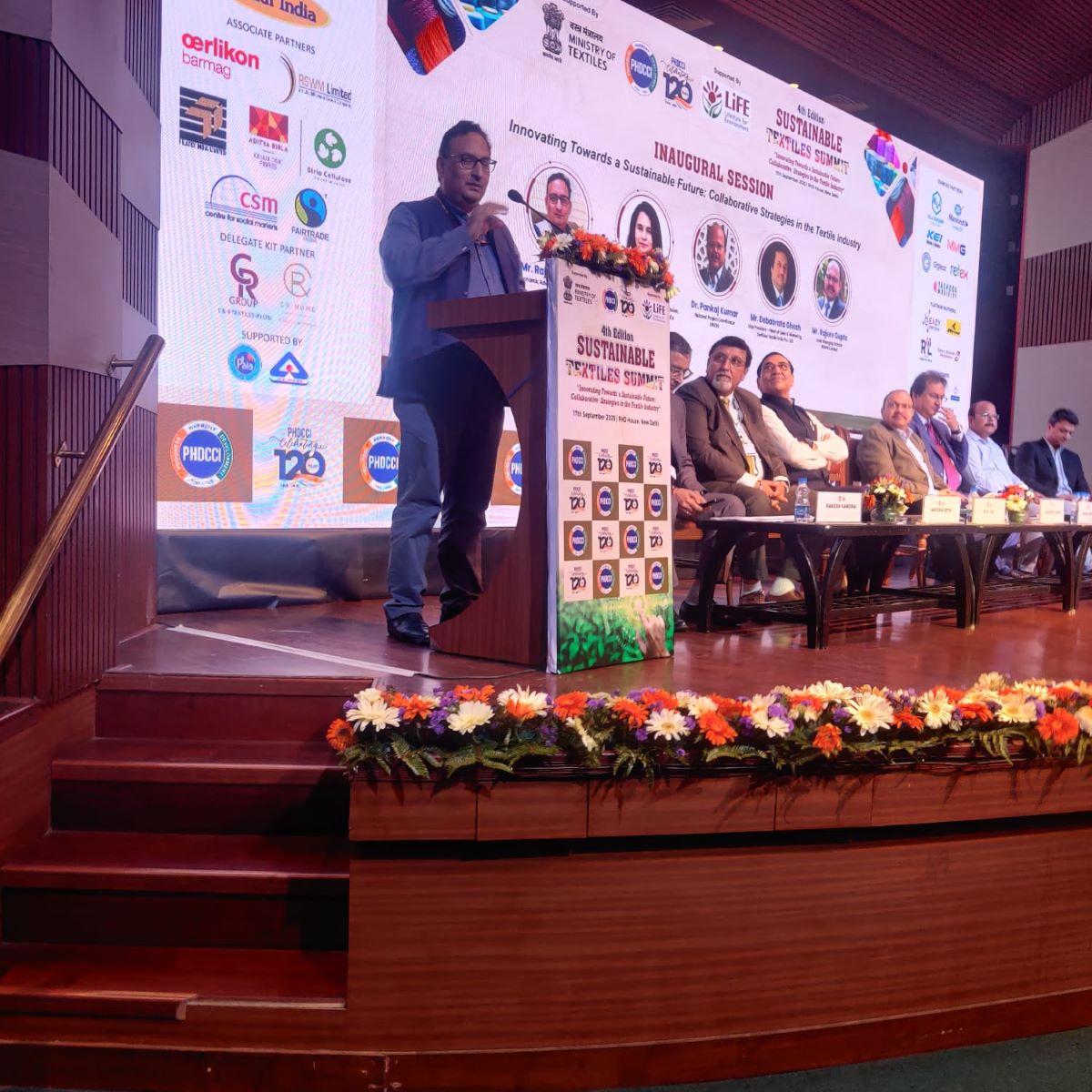
Address by Rajinder Kumar, Economic advisor GoI (Textiles).
4th Edition Sustainable Textiles Summit 2025 | September 17, 2025
Compiled by: Salil Chawla, Director, DFU Publications.
First of all, let me express my heartfelt gratitude to PHDCCI for organizing this wonderful event on such a critical topic—sustainability management. My special thanks to Zakir Hussain and Sree Devji Mukherjee for their efforts.
Being from the industry, I have had the privilege of interacting with them on many occasions, and it is always enriching.
I won’t take much of your time, but I would like to highlight a few key points. Before that, I must congratulate all our panelists for sharing such insightful perspectives on sustainability innovations in the textile sector.
For instance, Rajiv Mukherjee shared that 50 lakh PET bottles are processed every single day. This is the kind of information that many of us are often unaware of, and platforms like this help bring such achievements to light.
Viewing the Textile Sector as a System
One important request from many panelists has been government support for R&D and concerns regarding inverted duty structures in GST. Here, I would like to share a perspective, especially for the younger audience present today:
When we discuss a sector like textiles, we must view it as a part of a larger economic system. Basic economic principles, like input–output modeling, teach us that the output of one industry often becomes the input for another. The entire economy is interconnected.
For example, the government recently announced major reforms on September 3rd, where over 90% of inverted duty structures were rationalized in one stroke.
These changes will be implemented from September 22nd, offering significant relief to the textile sector.
PET, MEG, and GST Concerns
Some concerns were raised about PET being taxed at 18% while fibre attracts only 5% GST. Here’s the complexity: PET bottles fall under multiple ministries—Petrochemicals, Environment & Forests, and Textiles—because they begin as a petrochemical product, become a waste-management issue, and only later turn into textile fibre.
Interestingly, in the past six months, I have received many representations from the PET recycling industry, but not one representation highlighting this specific 18% GST issue.
Even before these reforms, the inverted duty structure existed—fibre was taxed at 12% then.
The government has now simplified GST into largely two slabs—18% and 5%—eliminating the 28% slab except for a few luxury and sin goods.
This is a massive structural change, even though some procedural issues may remain.
R&D and Innovation Support
Another point raised was the need for greater R&D funding. Let me assure you, the government has been actively supporting textile research for decades.
Just last week, I visited three leading textile research associations in Mumbai:
SASMIRA
Bombay Textile Research Association
World Research Association (WRA)
Under the NTTM scheme, we have allocated ₹150 crores for various projects through these associations. In total, eight such research bodies exist, most with a history of over 60–70 years, and they continue to receive significant government funding and administrative support.
Sustainability in Practice
Innovation and sustainability are at the heart of our vision for the textile sector. Many organizations, such as Oerlikon Barmag and RSWM, are doing outstanding work.
Let me share an example: I have a jacket made entirely from recycled PET bottles—produced not by a private company, but by Indian Oil Corporation. The quality and finish are on par with any conventional product, showing how waste can be turned into wealth.
The Bigger Picture
Finally, let’s not forget the larger economic transformation underway. Consider energy access:
Ten years ago, very few households had LPG or piped gas connections.
Today, major cities across India are fully covered, a change achieved in just the last six years.
Similarly, in textiles, petroleum by-products feed into fibre production, demonstrating how interconnected our sectors truly are.
Read our latest issue
The government remains committed to:
Supporting innovation
Driving sustainability
Listening to industry feedback
Ensuring structural reforms that benefit the entire ecosystem
With collaboration between industry, research institutions, and policymakers, I am confident the textile sector will continue to thrive while embracing sustainability and innovation.


 CONTACT US
