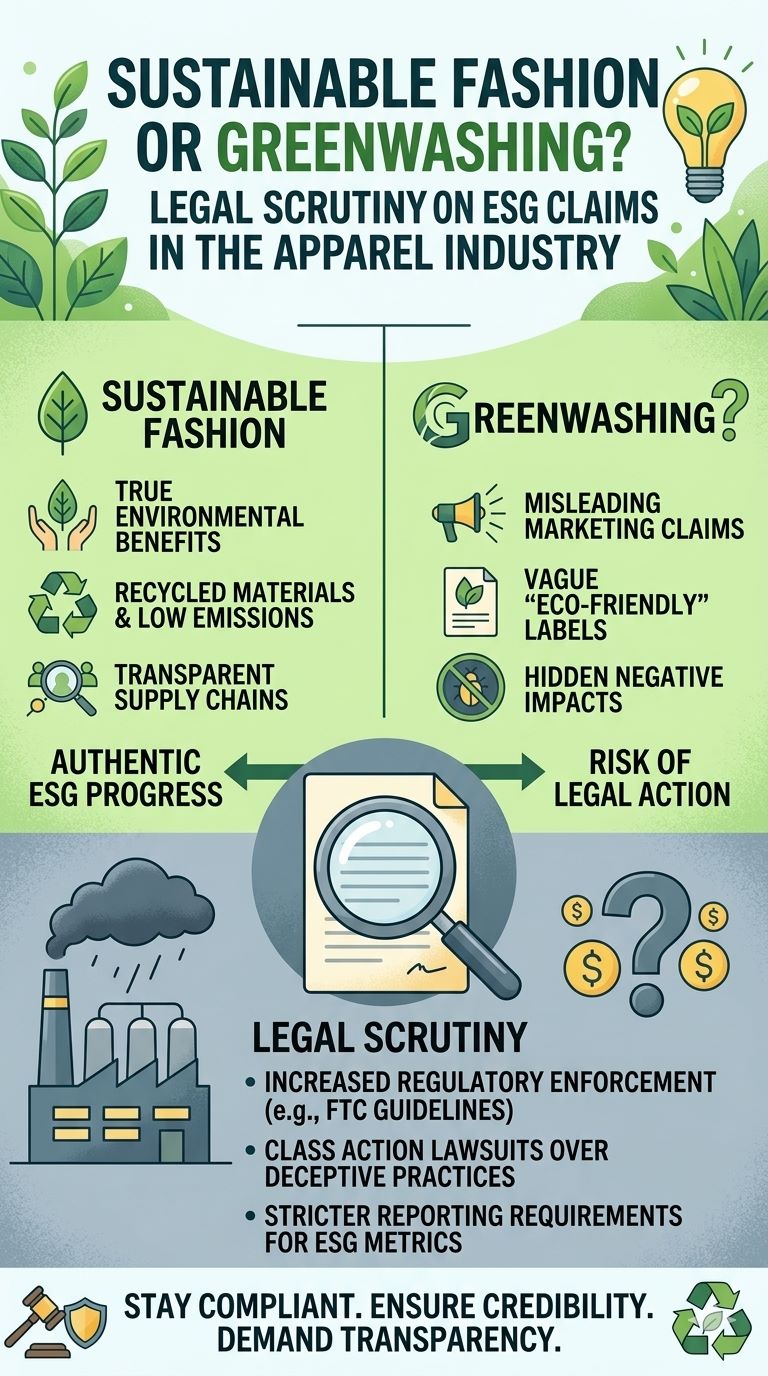
Sustainability has become one of the most commercially valuable narratives in the global fashion industry. Consumers are increasingly willing to support brands that claim to reduce environmental impact, utilise ethical sourcing practices, minimise waste, and promote responsible manufacturing. Terms such as "eco-friendly," "sustainable," "conscious," "green," "ethical," and "carbon neutral" have become common features of advertising campaigns, product labels, investor presentations, and corporate disclosures. While sustainability has evolved into a significant business differentiator, it has also become a source of growing legal scrutiny. The critical question facing regulators, consumers, and investors is whether these claims genuinely reflect corporate practices or merely constitute sophisticated marketing designed to capitalise on consumer sentiment.
The fashion industry is among the largest contributors to environmental degradation globally. Concerns relating to water consumption, textile waste, carbon emissions, chemical usage, labour conditions, and supply chain transparency have intensified public attention on the sector. In response, fashion companies have increasingly incorporated Environmental, Social, and Governance (ESG) commitments into their business strategies. However, the legal challenge arises when sustainability promises are communicated in broad, aspirational, or unverifiable terms that create an impression of environmental responsibility without adequate substantiation. Traditionally, sustainability claims were largely viewed as marketing statements with limited legal consequences. That position is rapidly changing. Environmental representations are increasingly being examined through the lens of consumer protection law, securities regulation, corporate governance obligations, advertising standards, and disclosure requirements.
As regulators worldwide focus on ESG-related disclosures, businesses can no longer assume that sustainability claims are immune from legal challenge merely because they involve future objectives or policy aspirations. In the Indian context, the Consumer Protection Act, 2019 provides a significant framework through which misleading environmental claims may be scrutinised. The Act prohibits unfair trade practices and misleading advertisements that misrepresent the quality, characteristics, orbenefits of goods and services. A sustainability claim that creates an exaggerated or inaccurate impression regarding the environmental attributes of a product may potentially attract regulatory intervention. The legal risk becomes particularly significant where consumers are induced to pay premium prices based on representations concerning ethical sourcing, recycled materials, reduced carbon footprints, or environmentally responsible production methods.
The issue becomes more complex because many sustainability claims are inherently difficult for consumers to independently verify. A garment labelled as environmentally friendly may involve multiple stages of production spread across various jurisdictions, suppliers, subcontractors, and manufacturing facilities. Consumers typically have limited visibility into these processes and therefore rely heavily upon the representations made by brands. This informational imbalance creates a heightened responsibility on businesses to ensure that environmental claims are supported by credible evidence and transparent reporting mechanisms. From a corporate governance perspective, ESG commitments are no longer confined to public relations exercises. Investors, lenders, regulators, and stakeholders increasingly evaluate companies based on sustainability performance and related disclosures.
In India, the Business Responsibility and Sustainability Reporting framework introduced by the Securities and Exchange Board of India has elevated the importance of ESG reporting among listed entities. Although disclosure requirements are intended to promote transparency, they also increase legal exposure.
Once a company publicly commits to measurable sustainability goals, inconsistencies between disclosures and actual practices may attract regulatory scrutiny, shareholder concerns, and reputational damage. One of the most significant legal risks emerging in this area is greenwashing. While there is no universally accepted statutory definition of greenwashing, the term generally refers to the practice of making environmental claims that are misleading, exaggerated, unsupported, or incapable of verification. Greenwashing may occur through explicit misrepresentations or through selective disclosure of favourable information while omitting material facts that would alter consumer perception. A company may highlight the use of recycled materials in a limited product line while failing to disclose environmentally harmful practices across its broader operations. Such representations may technically contain elements of truth while simultaneously creating a misleading overall impression.
CREDITS: Contributed by Sonam Chandwani, Managing Partner, KS Legal & Associates. The content has not been edited and reviewed by us.



 CONTACT US
