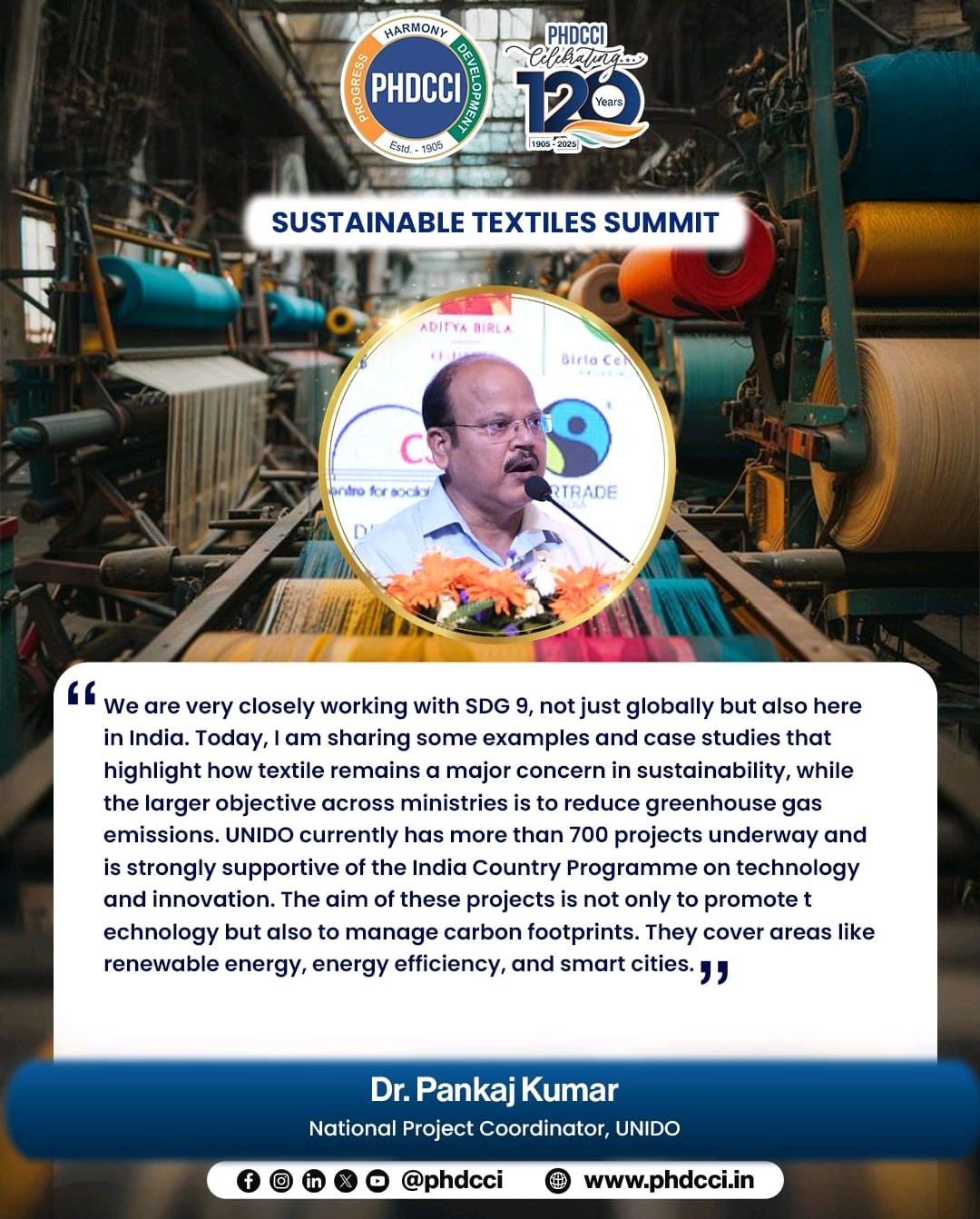
Address by Dr Pankaj Kumar l National Project Coordinator at UNIDO.
4th Edition Sustainable Textiles Summit 2025 | September 17, 2025
Compiled by: Salil Chawla, Director, DFU Publications.
India's textile industry is at a critical juncture, facing significant challenges related to chemical and energy use. A new six-year, UNIDO-led project, funded by the Global Environment Facility (GEF), aims to address these issues by eliminating hazardous chemicals and promoting cleaner technologies.
Eliminating Hazardous Chemicals
The project, titled "Eliminating Hazardous Chemicals from the Textile Fashion Supply Chain in India," is part of a larger global initiative. The urgency for this project is highlighted by a UNEP report that identifies over 8,000 chemicals used in textile production, many of which are hazardous.
A key goal is to eliminate 10,500 tons of toxic chemicals, working closely with India's Ministry of Environment, Forest, and Climate Change (MoEFCC) to ensure compliance with existing bans.
The project will provide funding and technical support to help micro, small, and medium enterprises (MSMEs) transition away from these harmful substances and adopt safer alternatives.
Promoting Energy Efficiency and Renewable Energy
Reducing the industry's reliance on fossil fuels is another major focus.
The project will encourage the adoption of energy-efficient and renewable energy technologies, building on successful past initiatives.
Waste Heat Recovery: Recovering waste heat from textile units can significantly reduce fossil fuel consumption.
Solar Energy: The project aims to leverage India's ambitious renewable energy targets by promoting solar photovoltaic (PV) for electricity and concentrating solar thermal (CST) technology for industrial thermal processes. CST, for example, can be used to preheat boiler feed water, directly reducing the need for conventional fuels.
Innovative Technologies: Support will be provided for highly innovative, though costly, technologies like supercritical CO2 dyeing machines, which drastically reduce water, energy, and chemical use.
A Roadmap for the Future
The project will also focus on developing a long-term technology roadmap for India's textile sector.
This roadmap will outline key milestones for 2026, 2030, and 2047, guiding the industry's sustainable growth. It will also address other crucial aspects of sustainability, including gender equality and the promotion of circular economy principles.
This includes thinking about resource efficiency, such as exploring alternative fibers like banana or areca fiber to reduce the use of pesticides.
Read our latest issue
Project Scope and Partnerships
The initiative will be executed in partnership with the Ministry of Textiles, which serves as the national executive partner. With a total financial commitment of approximately $51 million, including a $7.8 million GEF grant and significant co-financing from private partners like Aditya Birla and SRF, the project will target eight major textile clusters across six states:
Tamil Nadu: Surat, Tiruppur
Maharashtra: Ichalkaranji, Bhiwandi
Gujarat: Surat, Ahmedabad
Haryana: Panipat
Punjab: Ludhiana
West Bengal: Kolkata.
The project aims to support over 400 textile units within these clusters by providing the necessary financial and technical assistance to drive a transformative shift toward a more sustainable and circular textile industry in India.


 CONTACT US
