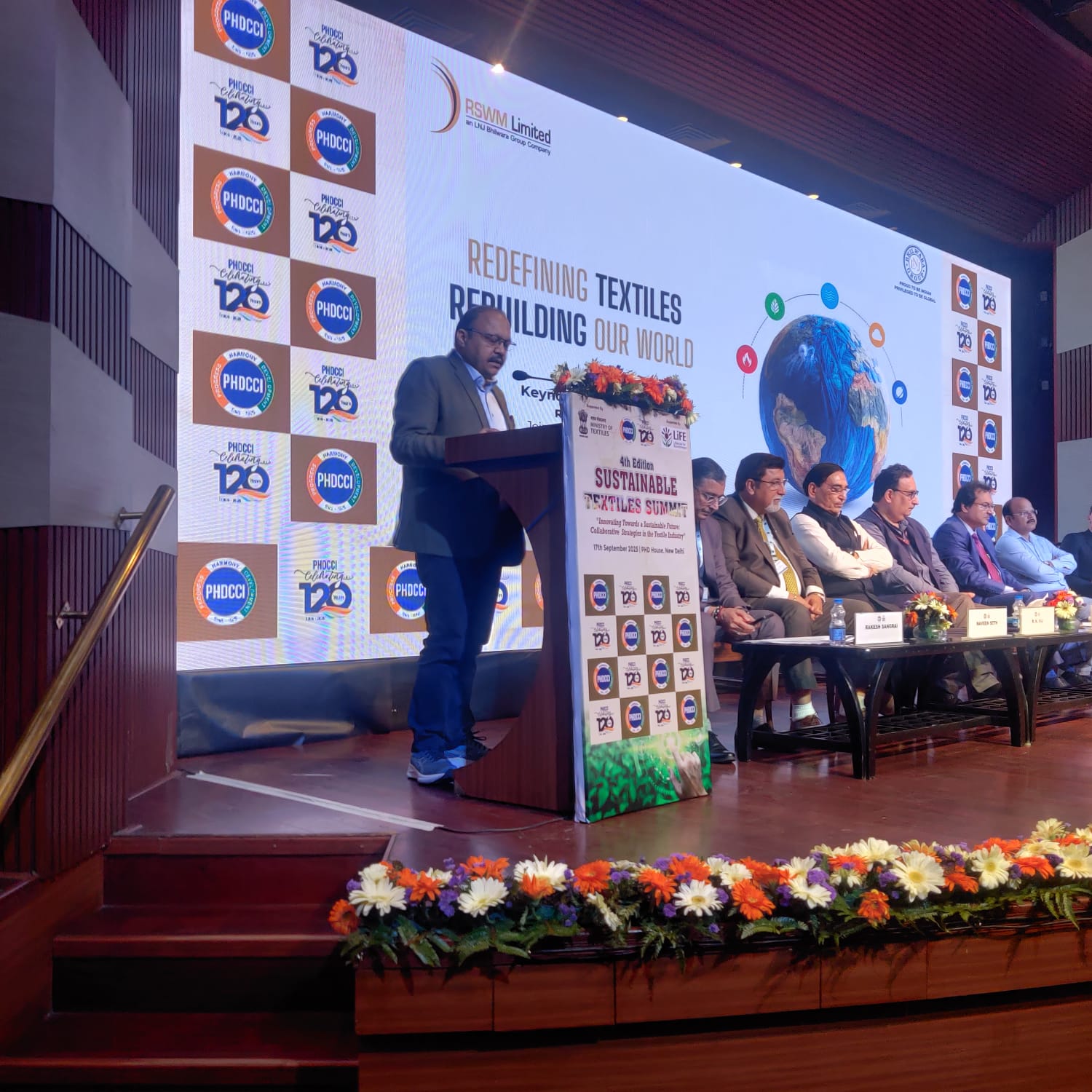
Address by Rajeev Gupta Joint Managing Director of RSWM Ltd.
4th Edition Sustainable Textiles Summit 2025 | September 17, 2025
Compiled by: Salil Chawla, Director, DFU Publications.
It is a privilege to share my thoughts on this important day—a day when policymakers, innovators, and business leaders have gathered to discuss the future of our industry. And what makes it even more special is that it coincides with the Honourable Prime Minister’s birthday, whose commitment to sustainability inspires us to make today’s dialogue truly meaningful.
The textile industry has always been at the heart of economic transformation. Both the first and second industrial revolutions were driven by textile innovations. Globally, countries like Bangladesh and Vietnam have reshaped their economies by making textiles a priority sector.
In India, textiles remain fundamental to our economy, society, and culture. It sits at the core of **Maslow’s hierarchy—“Roti, Kapda aur Makaan”—**and employs over 45 million people, making it one of the largest job creators in the country.
Sustainability: A Legacy and a Necessity
Sustainability is not new to India. Historically, we have practiced recycling and reuse as part of our culture. Wedding sarees and suits passed down generations, garments repurposed for multiple uses, even the barter system exchanging utensils for old clothes—these traditions reflected a natural instinct for conservation long before “sustainability” became a global buzzword.
But the world has changed. Fast fashion, mass consumerism, and environmental degradation have forced the industry to formally embrace sustainability—not as a slogan, but as a necessity. Over the last few years, what began as a compliance requirement or a brand statement has now become an integral part of business strategy worldwide.
Why Sustainability Matters
Resource Scarcity: Water, fossil fuels, and raw materials are finite. Without collective conservation and reuse, we risk severe depletion.
Regulatory Pressure: ESG norms, circular economy mandates, and global standards are becoming stricter, shaping how industries operate.
Consumer Expectations: Studies by McKinsey and PwC reveal that 67% of consumers prefer sustainable products, even if they cost more. Brands cannot ignore this sentiment.
Cost Efficiency: Sustainability does not always mean higher cost. Renewable energy, biofuels, and process innovations often reduce expenses while lowering the carbon footprint.
Industry Challenges and Opportunities
India has made progress in PET bottle recycling, collecting almost 90% of PET bottles today—something unimaginable a decade ago. Yet textile-to-textile recycling remains complex due to mixed fiber compositions and lack of standardized norms.
The way forward requires:
Advanced technologies like waterless dyeing and energy-efficient manufacturing
Clear global sustainability standards to harmonize efforts
Public-private partnerships to scale solutions.
Investment in circular design and next-gen materials
Companies like RSWM are already acting. We use 74 million kilowatts of green energy, recycle 50 lakh PET bottles daily, maintain zero liquid discharge plants, and source over 50% recycled polyester fiber. Sustainability is embedded into our monthly business reviews—not as an add-on, but as a core business responsibility.
Read our latest issue
The Road Ahead
India’s tradition of reuse, combined with technological innovation and policy support, positions us to lead in sustainable textiles. But this requires:
A mindset shift where sustainability becomes second nature
Standardized regulations and incentives for recycling and circular economy practices
Collaboration across government, industry, and consumers to drive large-scale impact
At RSWM and across the LNJ Bhilwara Group, we are committed to publishing our Sustainability Report annually, openly sharing our progress and challenges with all stakeholders.
Conclusion
The world is watching. With our heritage of conservation, innovative spirit, and industry resilience, India can emerge as a global leader in sustainable textiles.
Sustainability is no longer an option—it is the future of our industry, the responsibility of our generation, and the legacy we must leave behind.


 CONTACT US
