





_large.jpg)



Preface
The built environment is undergoing a profound transformation. Rapid urbanization, sustainability imperatives and the rise of smart cities are reshaping how we design and construct spaces. In this changing landscape, BuildTech—the application of technical textiles and composites in construction—has emerged as a pivotal enabler of modern architecture and infrastructure.
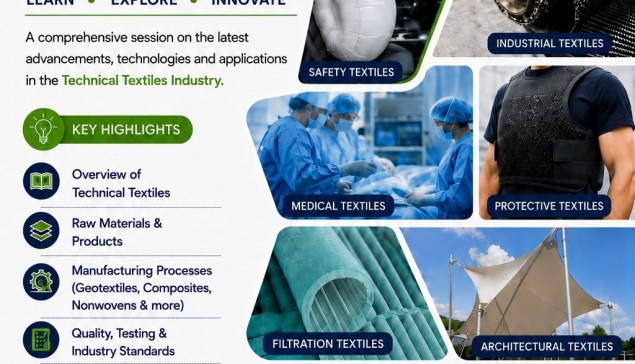
While the use of fabrics in construction dates back centuries, their evolution into high-performance structural and functional materials marks a major technological leap. Today’s BuildTech systems—tensile membrane roofs, façade meshes, acoustic insulation and safety nets—combine science, engineering and aesthetics in ways that traditional materials like concrete and steel cannot. This integration dissolves disciplinary boundaries among textile technology, civil and structural engineering, polymer science and architecture, fostering a truly interdisciplinary field of innovation.
Visit for more
This book, BuildTech: Textiles in Construction – Materials, Technology, Standards and Innovations, has been developed to bridge the gap between theory and practice. It brings together fundamental principles, manufacturing technologies, standards and market insights, with a special emphasis on the Indian scenario and global best practices.
Part I – Foundations introduces the scope, classification and raw materials of construction textiles, establishing the scientific and material base for the subject.
Part II – Applications illustrates how BuildTech materials are used in real-world projects—ranging from scaffolding nets, façades and membranes to noise and thermal insulation systems. Each application area is supported by detailed case studies of landmark projects in India and abroad, demonstrating how design, materials and engineering come together in successful implementations.
Part III – Technology & Manufacturing explains the processes that transform fibres and polymers into high-performance materials, including weaving, coating, lamination and composite fabrication, with diagrams and flowcharts for clarity.
Part IV – Standards & Testing consolidates international and Indian standards (EN, ISO, ASTM, BIS), covering fire retardancy, UV resistance, acoustics and thermal insulation.
Part V – Industry & Market maps global hubs and key manufacturers, identifying emerging demand drivers across regions.
Part VI – The Indian BuildTech Scenario evaluates manufacturing capacity, policy frameworks, R&D directions and opportunities for startups under the National Technical Textiles Mission (NTTM) and Smart Cities Mission.
Sustainability
The concluding chapter, Building the Knowledge and Innovation Ecosystem, focuses on the need for interdisciplinary education and research collaborations among textile, civil, polymer and architectural disciplines to strengthen India’s BuildTech capability.
Credits: Contributed by Dr. J. V. Rao Professor (Retd.), Anna University l Former Director General, NITRA l Former CEO, Textile Sector Skill Council (TSC) using Linkedin Post.


 CONTACT US
