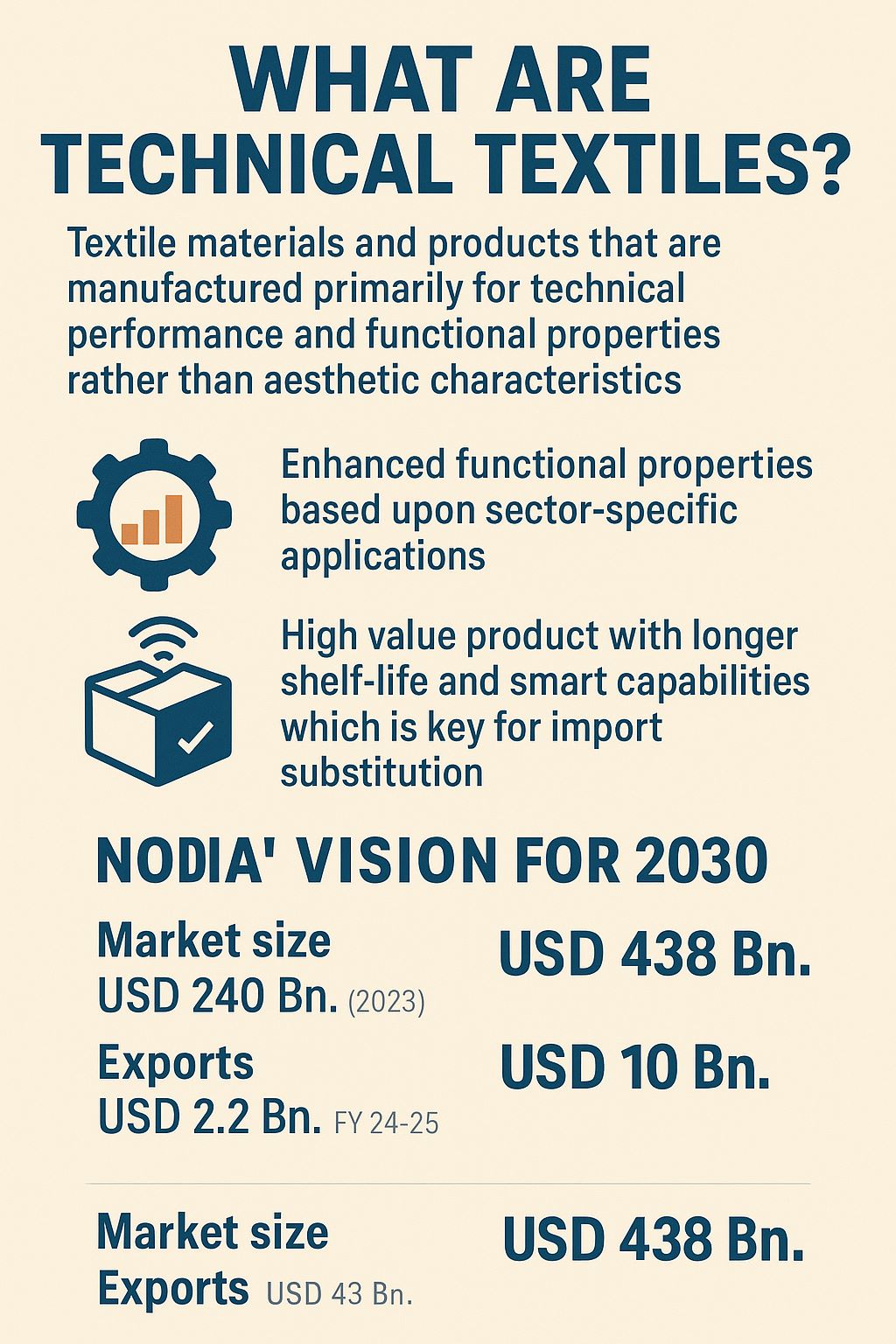
“India’s Technical Textiles: From Nascent Niche to Strategic Growth Engine”.
Key Facts & Figures
India’s technical textiles market is currently valued at US$ 29 billion (FY 2024), showing strong growth in recent years.
The sector contributes roughly 0.7% to GDP and makes up about 13% of the overall textiles & apparel market.
Despite growth, the penetration of technical textiles in India is still modest — 5–10%, compared to 30–70% in many advanced economies.
Fashion Guru
Government Schemes & Policy Support
The National Technical Textiles Mission (NTTM), launched in 2020-21 with an outlay of ~ ₹1,480 crore, aims to promote research, market development, exports, and skills in technical textiles.
Join our group
Production Linked Incentive (PLI) schemes recently extended to include technical textiles are driving investment in modern, high-value segments.
Infrastructure initiatives like PM MITRA Parks are being used to create textile manufacturing hubs with better plug-and-play facilities.
The Union Budget 2025-26 increased allocations for the textile ministry, including for technical textile segments.
Join our community
Strengths & Opportunities
Strong raw-material base: India is already a major producer of cotton, jute, silks, and is building capacity in man-made fibres, which benefits technical textile outputs.
Rising demand in sectors like medical textiles, protective gear, agriculture, mobiltech (automotive), buildtech, etc., especially post-COVID, which led to a surge in local manufacture of PPE, masks etc.
Export growth: In FY 25, technical textile exports rose significantly.
SUSTAINABILITY
Challenges & Gaps
Low machinery & technology penetration: India still depends heavily on imported hi-tech machinery, which raises costs and slows scale-up.
Skilling & R&D: While policies exist, the scale of skilled human resource; education; and dedicated R&D in newer smart/functional textile fields still lag.
DFU Profile
Standards, regulation & quality control: For advanced technical textiles (e.g. for safety, healthcare, automotive), meeting global norms is essential; India is working on many standards but uptake isn’t uniform.
Scale of investment: Though growing, the scale of capital investment in high-end technical textiles is still much smaller compared to what would be needed to match developed country producers.
Outlook
India aims to expand domestic technical textiles market size to US$ 40-50 billion by mid-2020s under NTTM and related initiatives.
With increasing global demand, push toward self-reliance (“Make in India”), improved incentives, many segments (e.g. meditech, protectech, mobiltech) are likely to see sharper growth.
If India addresses the gaps in technology, standards, and skill, the sector could become not just a large domestic base but a major exporter and innovator in smart / functional textiles.
CREDITS: This is automated information generated from the internet and has not been reviewed & edited by us.


 CONTACT US
