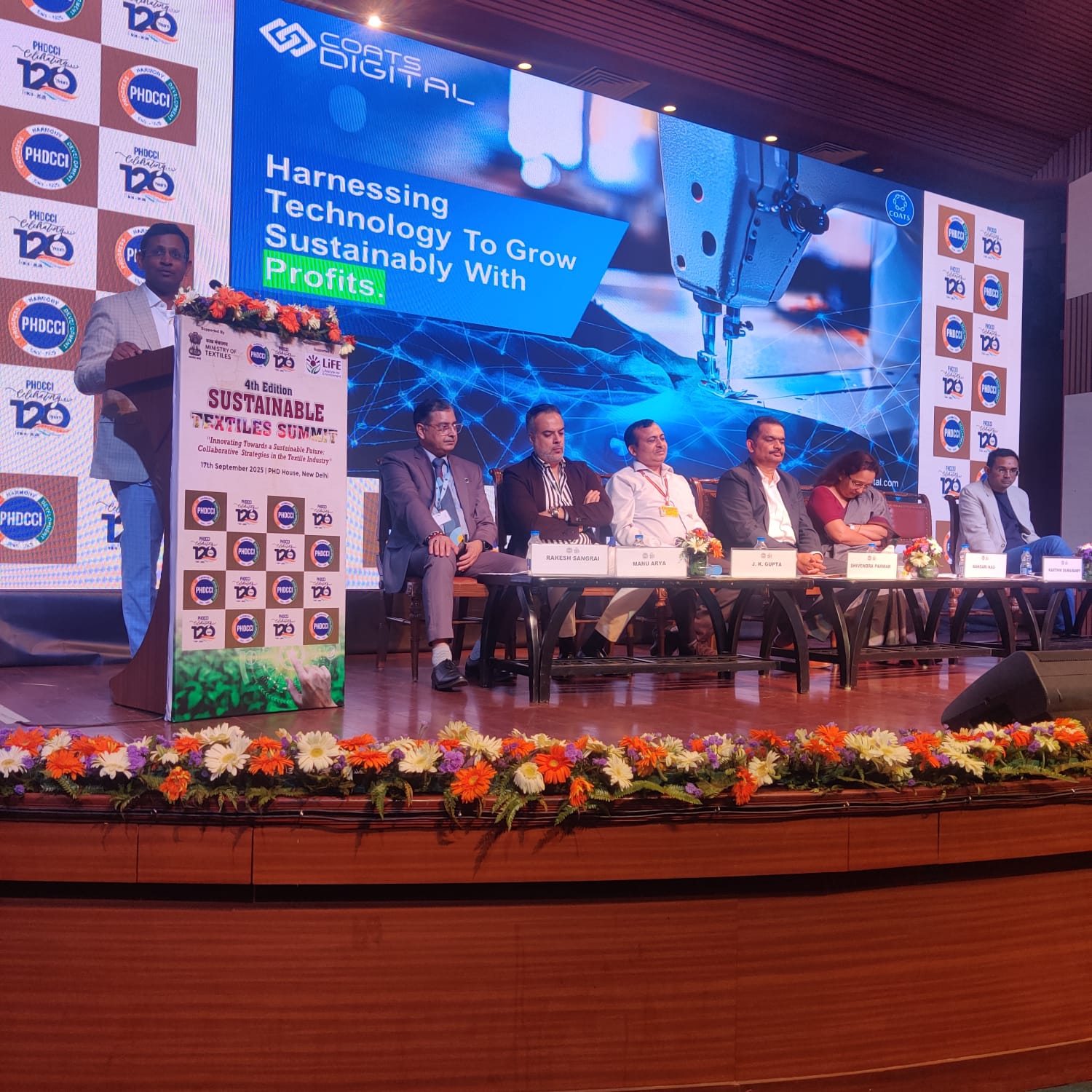
Address by Karthik T Duraisamy l Director Sales & Customer Success - South Asia @ Coats Digital .
4th Edition Sustainable Textiles Summit 2025 | September 17, 2025
Compiled by: Salil Chawla, Director, DFU Publications.
Enterprises—big or small—cannot survive without sustained profitability. When a business collapses, it disrupts the livelihoods of hundreds of families. It is in humanity’s best interest to help businesses stay profitable and resilient so they can continue contributing to society and maintain stability in today’s volatile economic landscape.
At Coats PLC, a 270-year-old global leader in threads and textiles, sustainability is at the heart of operations. In India, with factories in Faridabad, Madurai, Ambasamudram, and Srinagar, we have invested millions of dollars to ensure zero liquid discharge, waste recycling, and solar energy adoption.
Our plants recycle water to potable quality, convert chemical waste into inputs for other industries, and even repurpose bacterial biomass into organic fertilizers for local farmers. Today, most facilities in India run on nearly 100% solar power.
Customers, including leading brands like Nike and Adidas, value these efforts and are willing to absorb the 5–10% additional cost for sustainably produced goods.
This shows that consumers support cleaner practices when companies act transparently and responsibly.
However, smaller enterprises often lack the resources for such large-scale investments. This calls for collaboration among government, industry, and brands to support widespread adoption of clean technologies. A national push for sustainability could create manufacturing opportunities, consulting jobs, and global competitiveness, while positioning India as a zero-discharge, environmentally responsible manufacturing hub.
Additionally, digital transformation is key for profitable growth. By adopting digital tools, building a culture of frugality, empowering teams to identify risks early, and diversifying markets, organizations can navigate challenges such as tariffs, supply chain disruptions, rising costs, and geopolitical uncertainties.
Ultimately, sustainability and profitability are not trade-offs—they are mutually reinforcing goals.
If India commits to 100% sustainable manufacturing, it will protect the environment, generate employment, attract investments, and secure its position in global trade.


 CONTACT US
