






_large.jpg)



Positions sustainability as going beyond regulatory requirements
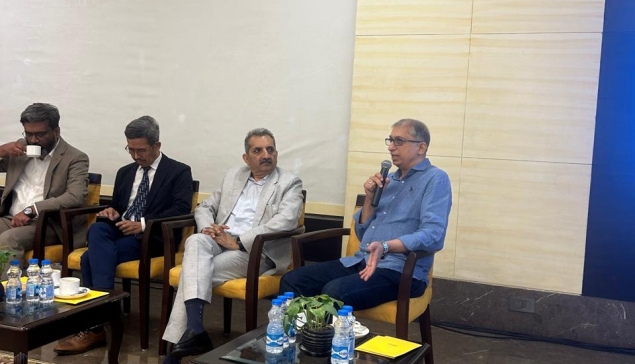
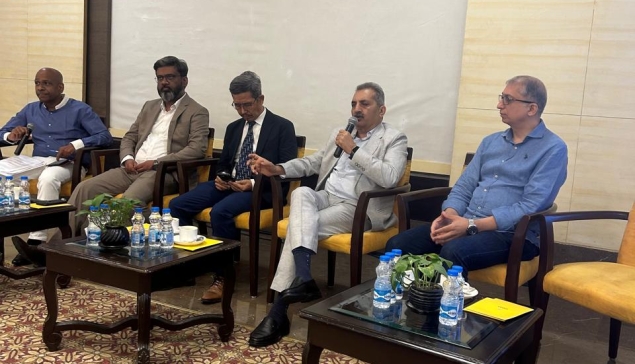
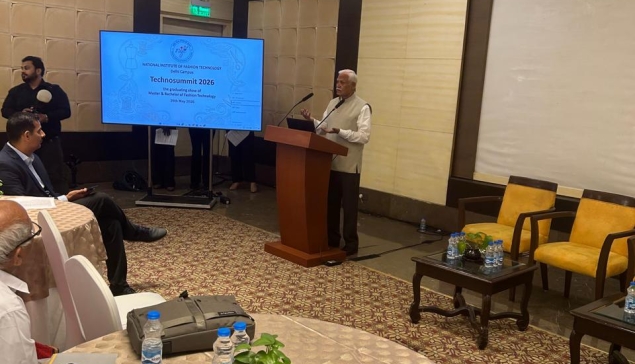
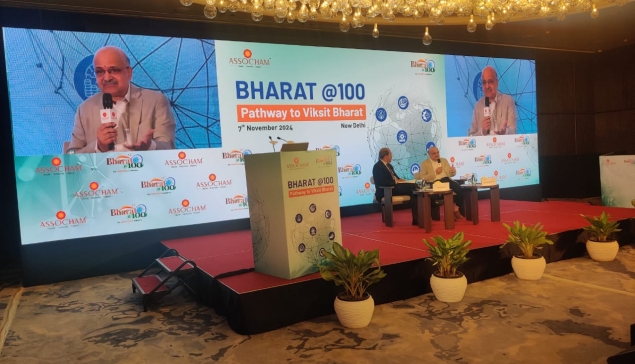
Dr. Ashok Kumar, Sector Expert and former Deputy Director General of the Bureau of Energy Efficiency, shared his insights on the textile industry’s sustainability quotient as one of the panelists referenced yesterday at Technosummit 2026.
Addressing the gathering on the future of sustainability and the textile sector, the speaker highlighted that the industry today stands at a critical turning point. Sustainability is no longer a peripheral discussion — it has become central to competitiveness, survival, and the long-term future of businesses worldwide.
Thanking the organisers and fellow panelists, the speaker began on a reflective note, reminding students and industry stakeholders that they are among the privileged few who have access to institutions, resources, intelligence, and opportunities that millions across the country do not possess. With such privilege, he noted, comes an equally important responsibility toward society, industry, and the planet.
Focusing on sustainability, he stressed that it extends far beyond conventional metrics such as energy intensity, carbon footprints, and emission values. While these measurements remain important, the global environmental crisis has now moved beyond statistics and reporting frameworks. Scientific institutions across the world are warning that the planet is approaching dangerous climatic thresholds. Several studies suggest that critical planetary boundaries have already been crossed, making immediate and collective action indispensable.
In this context, the textile and apparel industry has a particularly significant role to play. Sustainability today is not merely about environmental responsibility but also about maintaining competitiveness in a rapidly evolving global marketplace. Businesses must balance ecological priorities with economic realities.
The speaker further highlighted India’s climate commitments and evolving sustainability roadmap. India has pledged major reductions in emissions intensity, expansion of non-fossil fuel energy capacity, and long-term net-zero goals by 2070. These milestones, he explained, are not just government targets but collective responsibilities that industries, institutions, designers, manufacturers, and consumers must all contribute toward.
He also underlined India’s unique developmental challenge. Despite occupying only around 4% of the world’s landmass, India supports nearly 18% of the global population. This makes resource management, sustainable manufacturing, and responsible consumption even more critical for the country.
Turning specifically to textiles and fashion, the speaker emphasised that product design and lifecycle thinking will shape the future of the industry. Referring to studies on apparel consumption, he pointed out that even a single pair of jeans carries a substantial environmental footprint throughout its lifecycle — from manufacturing and washing to transportation and disposal. Therefore, sustainability cannot remain confined only to production processes; consumer behaviour and usage patterns are equally important.
He noted that innovation, technology, research, and collaborative industry efforts are gradually transforming the sector. However, both the supply side and demand side must work together to create meaningful impact. Consumers, brands, manufacturers, and policymakers all have an important role in driving responsible growth.
Concluding his remarks, the speaker expressed confidence in India’s progress, noting that among major economies, India continues to remain aligned with many of its climate commitments and sustainability pathways. Yet, he cautioned that the journey is far from complete. Considerable work still lies ahead, and the responsibility to build a sustainable future ultimately belongs to every stakeholder connected to the industry.
The session concluded with appreciation from the moderators and audience for the insightful perspective on sustainability, climate responsibility, and the evolving future of India’s textile ecosystem.


 CONTACT US
