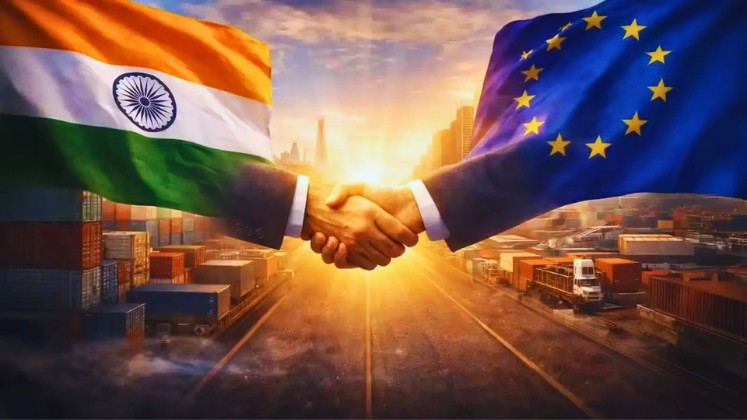
The Northern India Textile Mills’ Association (NITMA), wholeheartedly welcomes the landmark conclusion of negotiations for the India–European Union (EU) Free Trade Agreement (FTA). This historic milestone, announced at the 16th India-EU Summit, marks a transformative chapter for the Indian textile and apparel sector.
NITMA extends its profound gratitude to the Hon’ble PM, Shri Narendra Modi, for his visionary leadership and unwavering commitment to positioning India as a global economic powerhouse. The association also expresses its sincere appreciation to Shri Piyush Goyal, Hon’ble Minister of Commerce & Industry and Shri Giriraj Singh , Hon’ble Minister for Textiles, along with the committed officials of their ministries ,for their tireless efforts in navigating these complex negotiations to secure a "balanced and fair" deal that safeguards the interests of the domestic industry while unlocking unprecedented global opportunities.
After nearly two decades of negotiations, India has concluded a landmark Free Trade Agreement with the European Union, securing zero-duty access for Indian exports and reshaping their entry into Europe. Bringing together two of the world’s largest economies, accounting for nearly a quarter of global GDP, the deal arrives at a crucial time for India’s textile and apparel sector.
With U.S. exports facing higher tariffs and global sourcing patterns shifting, the EU agreement provides a vital counterbalance.
The EU stands as India’s second-largest export destination for textiles and apparel. With the EU’s global imports valued at USD 263.5 billion , the FTA provides Indian exporters with a massive runway for growth. By securing zero-duty access and eliminating tariffs of up to 12%, the agreement effectively removes the long-standing disadvantage Indian exporters faced against competitors like Bangladesh, Pakistan, and Turkey.
"This India–EU FTA could be a game-changer for the Indian textile value chain however its impact will depend on execution, innovation, sustainability, and the industry’s ability to deliver value in a demanding market," said Shri Sidharth Khanna, President of NITMA.
Key benefits for the Textile Sector: The FTA grants zero-duty access across all textile tariff lines, boosting major segments like garments, cotton, and MMF textiles. It will energize 342 districts and key clusters, supporting 45 million livelihoods. Beyond tariff cuts, the pact tackles non-tariff barriers with regulatory cooperation and customs facilitation, while driving investment, technology transfer, and sustainable 'green manufacturing' aligned with EU standards.
Mr. Khanna, advocating for FTA fairness and balance, highlighted a long standing critical duty anomaly in the current India-ASEAN FTA, where raw Polyester Staple Fibre (HS 55032000) faces a 5.5% BCD while finished Polyester Spun Yarn (HS 55092100) enters duty-free. This imbalance has triggered a tenfold surge in imports—rising from 8.4 to 82.7 million kgs, severely disadvantaging Indian mills and prompting NITMA to demand tariff parity across both HSN codes ongoing review of the India-ASEAN FTA, to ensure fair competition.
The India–EU FTA, coupled with recent pacts with the UK, Oman, and New Zealand, solidifies India’s status as a premier, sustainable sourcing partner, paving the way for a resilient and inclusive Viksit Bharat
CREDITS: PR from official NITMA WhatsApp chat. The content has not been edited and reviewed by us.


 CONTACT US
