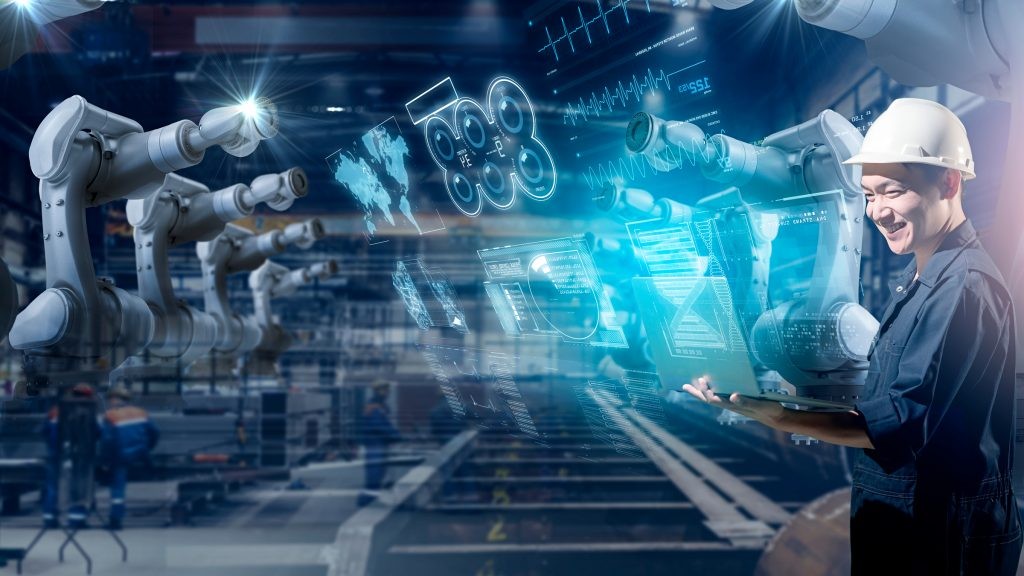
The textile and apparel manufacturing sector in India ranks as the second-largest provider of employment and stands as the foremost contributor to the nation’s GDP. The textile sector recognizes digital transformation as a key driver for sustainability and competitiveness. Consequently, there has been an increasing focus on the potential of technology to transform the supply chain within the fashion and textiles industry.
The adoption of strategic and efficient solutions, such as task automation, virtual reality, big data, and revolutionary technologies like blockchain, 3D virtual technologies, and the Internet of Things, are propelling transformations within the supply chain.
Advanced technologies such as AI, robotics, and cloud computing play a crucial role in improving transparency and operational efficiency.
The textile and fashion industries are experiencing transformations across various levels of their supply chains, from the production of raw materials to the consumer experience.
Digitalization in fashion boosts the implementation of robust, innovative, sustainable, and real-time infrastructure that is tailored to the requirements of the customer concerning comfortability, flexibility, and reliability in a sustainable manner.
Smart Manufacturing & Industry 4.0
IoT & Smart factories – The Internet of Things (IoT) encompasses tangible objects that are integrated with sensors, computational capabilities, and software, enabling them to interact with other devices and systems via the Internet or wireless communication networks. Sensors track machine performance, fabric defects, and energy use, enabling predictive maintenance, better quality and higher efficiency.
Automation & Robotics – these are used from the designing to production process and product transportation of the industry. Robotics can be seen in handling of bales and fabric, laser cutting, folding and packing. Use of automated looms, automation in spreading, cutting and sewing of fabric, are improving speed, accuracy, and scalability. This in turn is helping to minimize errors and wastes and also reduce the production cost.
One example is the robot “Sewbo” invented by Zornow in 2015 which can sew a T-shirt from start to finish. LOWRY SewBot, invented by “Softwear Automation” USA, can analyse and manipulate the fabric like human.
Digital twins (DT) – Digital twin technology is based on the logic of mirroring people's appearances, choices, and characteristics. It is a computer-generated representation of a physical entity or system and is perceived as a key enabler of digital transformation (Kritzinger et al., 2018). The DT is represented as a software object or model that encapsulates a distinct physical object, process, organization, person, or other abstraction (Singh et al., 2021).
DT enhances various elements of garment sustainability by offering technical information, including insights into the product's history, the materials utilized, and its resource consumption and emissions, as well as guidance on textile maintenance or repair, ultimately leading to reduced energy and detergent usage.
Blockchain & Supply Chain Transparency
Traceability has become an essential requirement for production that spans multiple tiers and sites. It provides visibility and addresses the consumer demands for transparency and quality assurance. The textile and clothing industry exemplifies the necessity for implementing traceability to tackle existing issues of information asymmetry and limited visibility.
Blockchain enables customers to verify where and how garments were produced—supporting ethical sourcing. It also ensures Fair Trade & Authenticity and hence, protects traditional Indian weaves and handicrafts from counterfeiting.
Smart Textiles
According to ISO/TR 23383, smart textiles reversibly interact with their environment and respond or adapt to changes in the environment (Sajovic, et al., 2023). Wearables embedded with sensors for health monitoring or adaptive clothing (temperature-regulating fabrics). In the current scenario, user-defined textile wearables are extensively used in numerous fields, including healthcare, sports, military, and different defense-related projects.
These call for some modification like addition of some textile–based or non-textile-based sensors or actuators to detect changes in the environment and then respond accordingly. E-textiles which signifies a textile structure embedded with electrical or electronic functionality, are also being used in healthcare, personal protection equipment (PPE), sports/leisure, military and fashion apparels.
Artificial Intelligence (AI) Data Analytics
The rise of big data has positioned the textile and apparel sector at a pivotal point in their interactions with consumers, suppliers, and competitors. It has become essential for them to handle substantial volumes of data to enhance decision-making processes. In these situations, AI techniques have demonstrated potential across all areas of the T&A (Textile and Apparel) value chain, from product discovery to robotic manufacturing.
The extensive applications of AI in the T&A industry have been integrated into design support systems, T&A recommendation systems, intelligent tracking systems, quality control, T&A Trend forecasting, and predictive analytics within supply chain, Inventory optimization and Personalized shopping.
Recommendation engines suggest clothing based on consumer tastes and purchase history and reduce overproduction. The rise in computing power, the availability of open-source machine and deep learning models, advancements in specialized hardware, system architecture, and cloud technology for AI capabilities aimed at the T&A industry present extensive opportunities and potential for growth in the near future.
Rise of Digital Fashion and Metaverse:
The metaverse is a virtual three-dimensional (3D) environment where real-world people and things can freely circulate, exchange, and interact with one another (Dwivedi et al. 2022). The integration of virtual reality (VR) and augmented reality (AR) technologies has facilitated seamless exploration within three-dimensional (3D) environments.
The use of the metaverse in the digital fashion economy equips designers with the necessary tools to create a brand that prioritizes environmental sustainability and to collaborate with suppliers committed to sustainable practices.
3D Design & Virtual Prototyping – Designers can visualize garments digitally, reducing waste from sample production.
Virtual fitting rooms – Customers can “try on” outfits using AR/VR before purchase.
Digital fashion shows – 3D avatars and metaverse runways are emerging as sustainable alternatives to physical shows.
Thus, we see that, in addition to modernizing production, emerging technologies are increasing the competitiveness, sustainability, and customer focus of India's textile and fashion sector. India is emerging as a global leader in fashion innovation thanks to the combination of tradition and technology. Businesses may increase operational effectiveness while reducing environmental effects by working with legislators and utilizing creative ideas, which will guarantee their competitiveness in the long run.
References:
Dwivedi, Y. K., Hughes, L., Baabdullah, A. M., Ribeiro-Navarrete, S., Giannakis, M.,Al-Debei, M. M., ... & Wamba, S. F. (2022). Metaverse beyond the hype:
Multidisciplinary perspectives on emerging challenges, opportunities, and agenda for research, practice and policy. International journal of information management, 66, 102542.
Kritzinger, W., Karner, M., Traar, G., Henjes, J. & Sihn, W. (2018). Digital twin in manufacturing: A categorical literature review and classification. IFACPapersOnLine, 51(11), 1016–1022. https://doi.org/10.1016/j.ifacol .2018.08.474
Singh, M., Fuenmayor, E., Hinchy, E., & Qiao, Y. (2021). Digital twin: Origin to future. Applied System Innovation, 4(2), 36. https://doi.org/10.3390/asi4020036
Sajovic, I., Kert, M., & Boh Podgornik, B. (2023). Smart Textiles: A Review and Bibliometric Mapping. Applied Sciences, 13(18), 10489. https://doi.org/10.3390/app131810489
CREDITS: Authored article contributed by Harsha Rani, Assistant professor NIFT Bengaluru.


 CONTACT US
