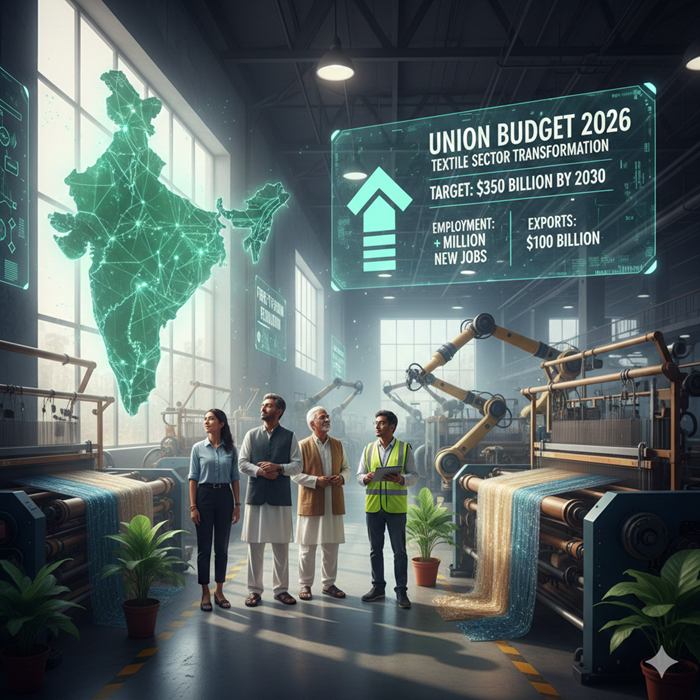
The Union Budget 2026–27 has unveiled a landmark policy framework for the textile sector, signaling a paradigm shift from traditional support to a high-growth, "Fibre-to-Fashion" integrated model. Recognizing the sector's critical role in employment and exports, the Government has introduced comprehensive measures to bolster infrastructure, sustainability, and MSME liquidity.
The Integrated Programme for the Textile Sector : The centerpiece of this year's budget is a new, five-pillar Integrated Programme designed to enhance self-reliance and global competitiveness:
National Fibre Scheme: Aimed at achieving 100% self-reliance across the spectrum, including silk, wool, jute, man-made fibres (MMF), and innovative "new-age" materials.
Know More
Textile Expansion and Employment Scheme: A modernization drive providing capital support for advanced machinery and technology upgradation in traditional clusters.
National Handloom and Handicraft Programme: A unified platform to preserve India’s heritage by providing targeted financial and operational support to weavers and artisans.
Tex-Eco Initiative: A "Green Reset" to align Indian manufacturing with international environmental standards and capture emerging sustainable market opportunities.
Samarth 2.0: A modernized skilling ecosystem built on industry-academic partnerships to ensure a steady pipeline of industry-ready talent.
Scaling Up: Mega Parks and Technical Textiles: To drive economies of scale, the Government will establish Mega Textile Parks via a "challenge mode" selection process. These hubs will prioritize Technical Textiles—a high-value segment essential for medical, defense, and infrastructure applications.
Rural Empowerment: Mahatma Gandhi Gram Swaraj Initiative : Complementing the One District One Product (ODOP) initiative, this new scheme focuses on:
Global market linkages and branding for Khadi and village industries.
Process modernization and quality improvement for rural youth and artisans.
Boosting Export Competitiveness
In a move to improve working capital management, the export obligation period for garment and leather exporters using duty-free inputs has been extended from 6 months to 12 months. This provides critical operational flexibility in a volatile global market.
MSME Liquidity and "Champion" Enterprises : The budget addresses the credit gap for MSMEs through a two-pronged strategy:
TReDS Enhancement: Strengthening the Trade Receivables Discounting System by mandating its use by CPSEs and linking it with the Government e-Marketplace (GeM).
SME Growth Fund: A dedicated ₹10,000 crore fund has been established to identify and incentivize high-potential MSMEs, transforming them into "Future Champions" of the industry.
NITMA, while appreciating these initiatives , said that " The Union Budget 2026–27 provides a roadmap to transform India into a global manufacturing powerhouse while bridging the gap for inclusive development," as the focus now shifts to a collaborative implementation phase involving States, industry leaders, and skilling institutions to ensure these benefits reach every level of the value chain.
CREDITS: PR received from NITMA official WhatsApp chat. The content has not been edited and reviewed by us


 CONTACT US
