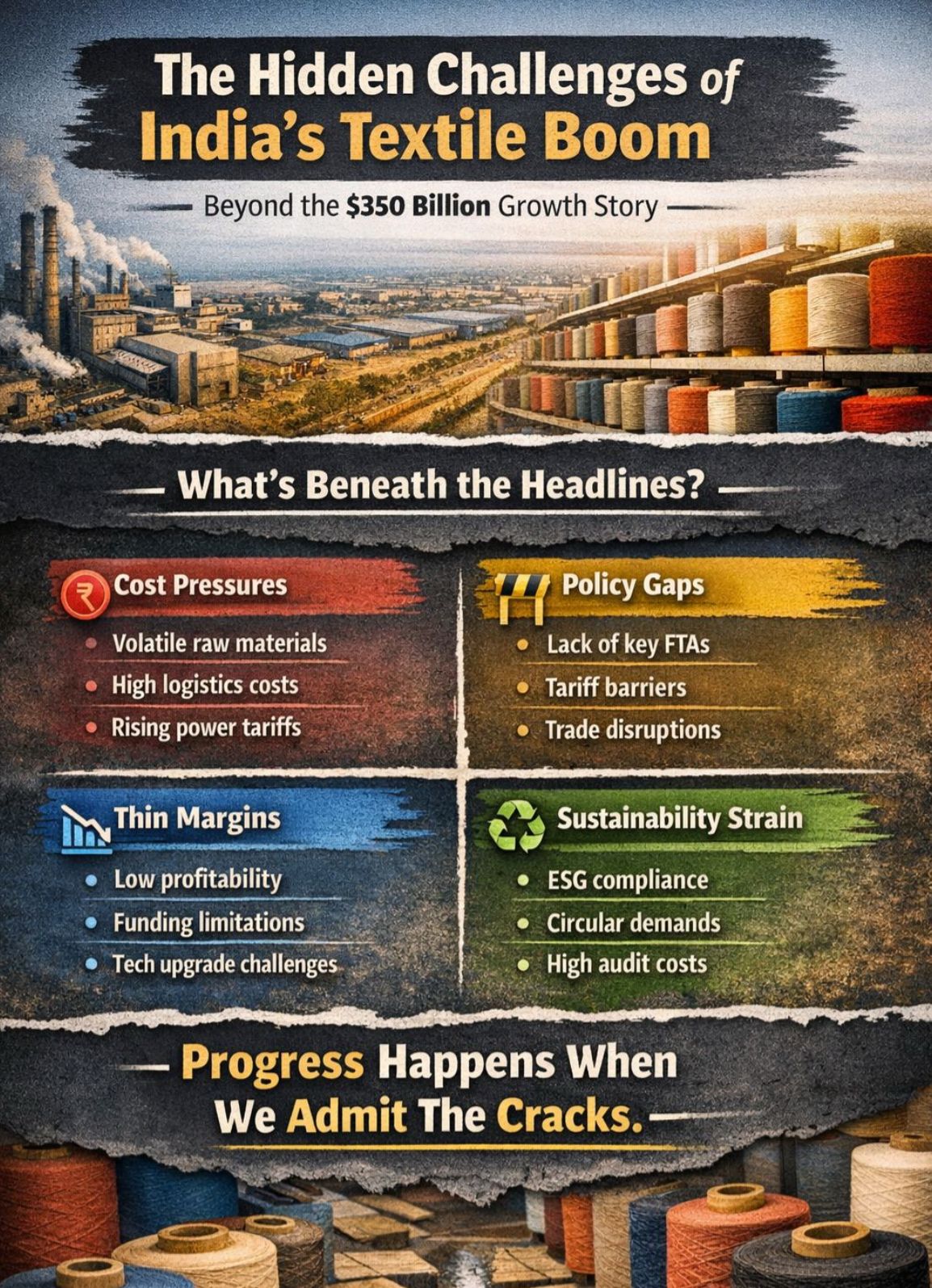
Yes, India’s textile and apparel industry is projected to reach ~$350 billion by 2030, powered by domestic consumption, export diversification, PM MITRA Parks, and the PLI scheme.
But growth headlines don’t tell the full story.
The real story lies in the pressure points beneath the numbers.
Let’s talk about them...plainly:
1. Cost pressures are structural, not cyclical.
Raw material volatility (cotton, polyester, PTA, MEG), rising power tariffs, logistics costs, and compliance expenses continue to squeeze manufacturers. Competing with countries that enjoy cheaper inputs and smoother logistics remains a daily challenge.
2. Policy mismatches hurt global competitiveness.
While peers benefit from deep FTAs, Indian exporters still face tariff disadvantages in key markets like the EU and UK. Recent trade disruptions have shown how vulnerable exports are to sudden duty changes and geopolitical shifts.
3. Margin realities are uncomfortable.
Despite higher production volumes, profit margins across MSMEs and mid-sized textile units remain thin. Limited access to capital makes technology upgrades, automation, and capacity expansion difficult, slowing productivity gains.
4. Sustainability comes with hard trade-offs.
Global buyers now expect traceability, ESG compliance, low-carbon manufacturing, and circularity. These are necessary, but they also raise costs, audit complexity, and operational strain, especially for India’s fragmented textile clusters.
Here’s the truth we often avoid:
India’s textile sector is growing...but sustainable, competitive growth is not guaranteed.
Ignoring these frictions won’t make them disappear.
Acknowledging them is the first step toward fixing them.
Progress becomes stronger when we admit the cracks.
What do you think is the biggest bottleneck holding India’s textile industry back today: costs, trade policy, margins, or sustainability compliance?
Credits: This piece of information is a reproduction of Linkedin post of Ms Neetika Agarwal who works closely with the textile and apparel ecosystem, creating industry-focused content on sustainability, supply chains, and evolving compliance requirements. She is interested in how practical insights and data can support better decision-making across the value chain.


 CONTACT US
