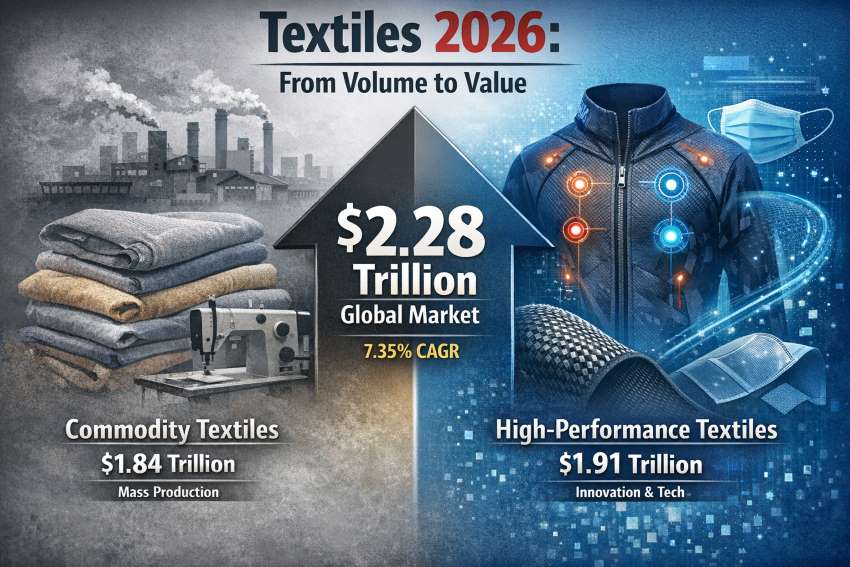
Where we want to head to year 2030:
Reaching to $100 Billion Through FTAs, Heritage Strengths and New Export Hubs
India’s textile and apparel sector (T&C) is sharpening its export strategy as it cruises towards an ambitious/aspirational target of $100 billion in exports by the year 2030, a leap from the current level of about $40 billion.
At the center of this plan is a decisive and resolute push/exhortation to double down efforts & shipments to Free Trade Agreement (FTA) partner countries which India so far is chugging along well, while strengthening & cementing India’s presence giving a heft to its export basket both in traditional and emerging global markets.
The Ministry of Textiles is charting a focused & resolute roadmap to realistically raise India’s share of textile exports to FTA destinations from current 5.8% to nearly 12% to meet this end.
A core pillar of this effort/structural shift is the promotion of high-value and culturally distinctive segments give heft to its exports volume—including Geographical Indication (GI) products, carpets, handlooms and silk—supported & backed up by sharper, calibrated & targeted branding initiatives which hitherto were lacking.
Furthermore, a diversification-led strategic approach is being steadfast pursued to improve & augment India’s footprint in the top 40 importing nations where broadly most of the textiles are been consumed on most of the parameters, on the other hand also aimed at lifting market share to more decent 10%, transitioning & translating into exports of $55–60 billion, vis a vis about $28 billion today.
It is to be emphasized here that, while established markets such as the US, EU and UK continue to account for over half of India’s textile exports, accelerated growth is being strategically targeted in Australia, Canada, Bangladesh, the UAE and Sri Lanka, which together contribute around one-fifth or thereabouts of the current shipments.
Equally crucial to the strategy is broadening (widening the horizon) the domestic export base. In the true federal democratic spirit states have been encouraged & motivated to harness new exporters/grounds up, support and handhold first-time participants, expand product portfolios/product line and integrate non-exporting districts into the national export ecosystem to do the needful.
Strengthening & consolidating market linkages more importantly for products that combine export potential, interestingly also wherever there is cultural relevance and high employment generation is seen as essential to making this growth both inclusive and sustainable to unlock job creation.
Power play.
Credits: This article is written using automated generated information by the Internet and ET edition dated 21-01-2026. The content has partially been edited and reviewed by us.


 CONTACT US
