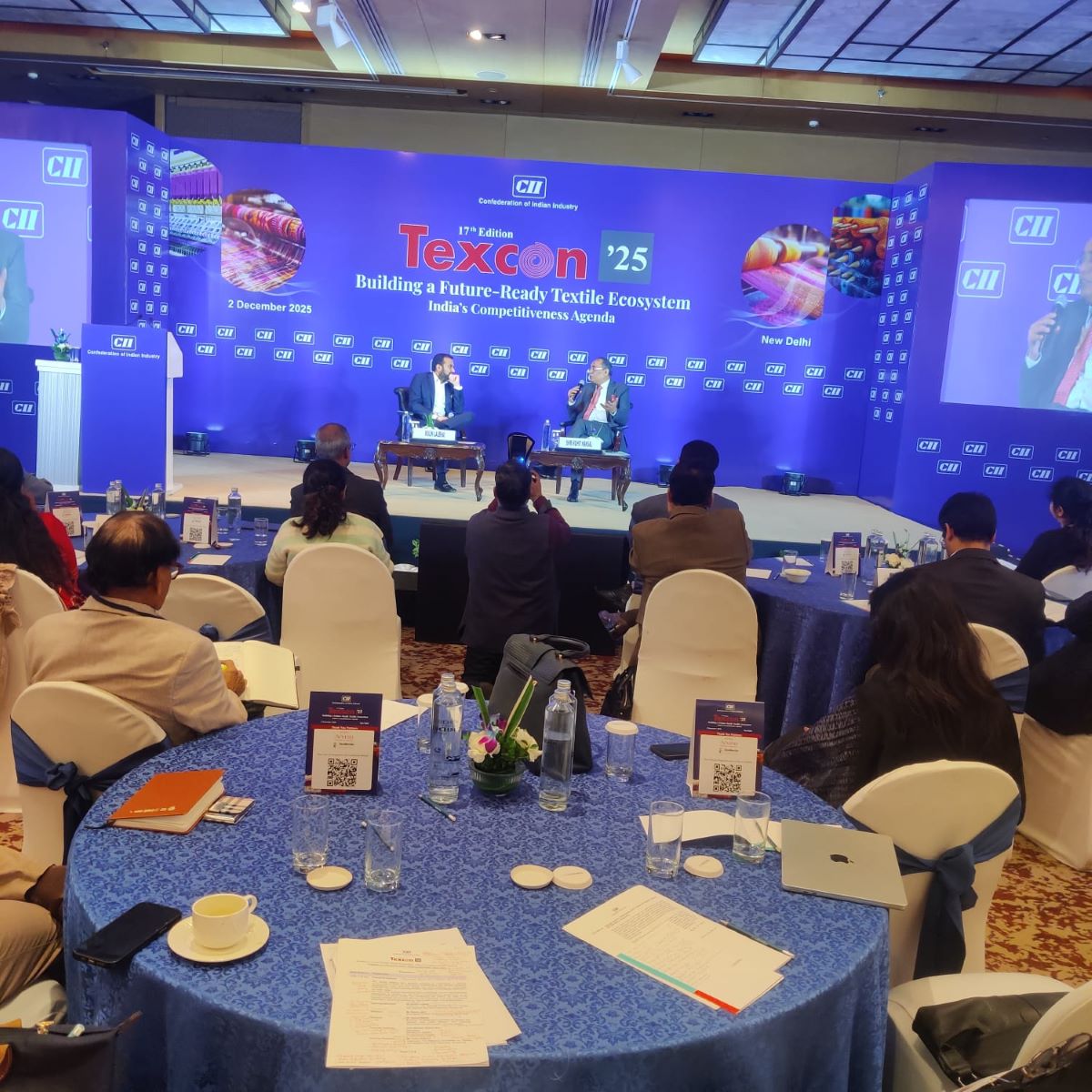
Complied by Salil Chawla, Director, DFU Publication, on the occasion of CII Textcon'25 Conference held in New Delhi on 02-12-2025.
Achieving India's vision for the textile and apparel industry (T&A) will require significant expansion across the value chain, supported by strong policy and investment enablers. India's textile and apparel sector must modernize and scale rapidly to strengthen its global position. Addressing challenges such as high financing costs, outdated machinery, and limited access to credit for MSMEs is essential.
The focus should be on unlocking private investment through easier credit, shared infrastructure, and support for large players to expand sustainably.
Flagship initiatives such as the Production Linked Incentive (PLI) Scheme 2.0, coupled with progressive central and state-level textile policies, are acting as powerful catalysts driving fresh investments, modernizing infrastructure, and accelerating technology-led transformation.
In addition, New Free Trade Agreements with partners like the UAE and Australia, along with ongoing negotiations with the UK and EU, are set to open major export opportunities. With the right push on technology, sustainability, and market access,
India can rewire its textile value chain for global leadership.
Join our community
Achieving India's vision for the textile and apparel industry will require significant expansion across the value chain, supported by strong policy and investment enablers. India's textile and apparel sector must modernize and scale rapidly to strengthen its global position. Addressing challenges such as high financing costs, outdated machinery, and limited access to credit for MSMEs is essential.
The focus should be on unlocking private investment through easier credit, shared infrastructure, and support for large players to expand sustainably.
Flagship initiatives such as the Production Linked Incentive (PLI) Scheme 2.0, coupled with progressive central and state-level textile policies, are acting as powerful catalysts driving fresh investments, modernizing infrastructure, and accelerating technology-led transformation.
In addition, New Free Trade Agreements with partners like the UAE and Australia, along with ongoing negotiations with the UK and EU, are set to open major export opportunities. With the right push on technology, sustainability, and market access, India can rewire its textile value chain for global leadership.
VIEW
Highlighting the interaction between Rohit Kansal, Additional Secretary, Ministry of Textiles, Government of India with Kulin Lalbhai, Chairman, CII National Committee on Textiles and Apparel and, Vice Chairman, Arvind Ltd.
CREDITS: Derived from Texcon'25 CII conference official agenda booklet. The content has not been edited and reviewed by us.


 CONTACT US
