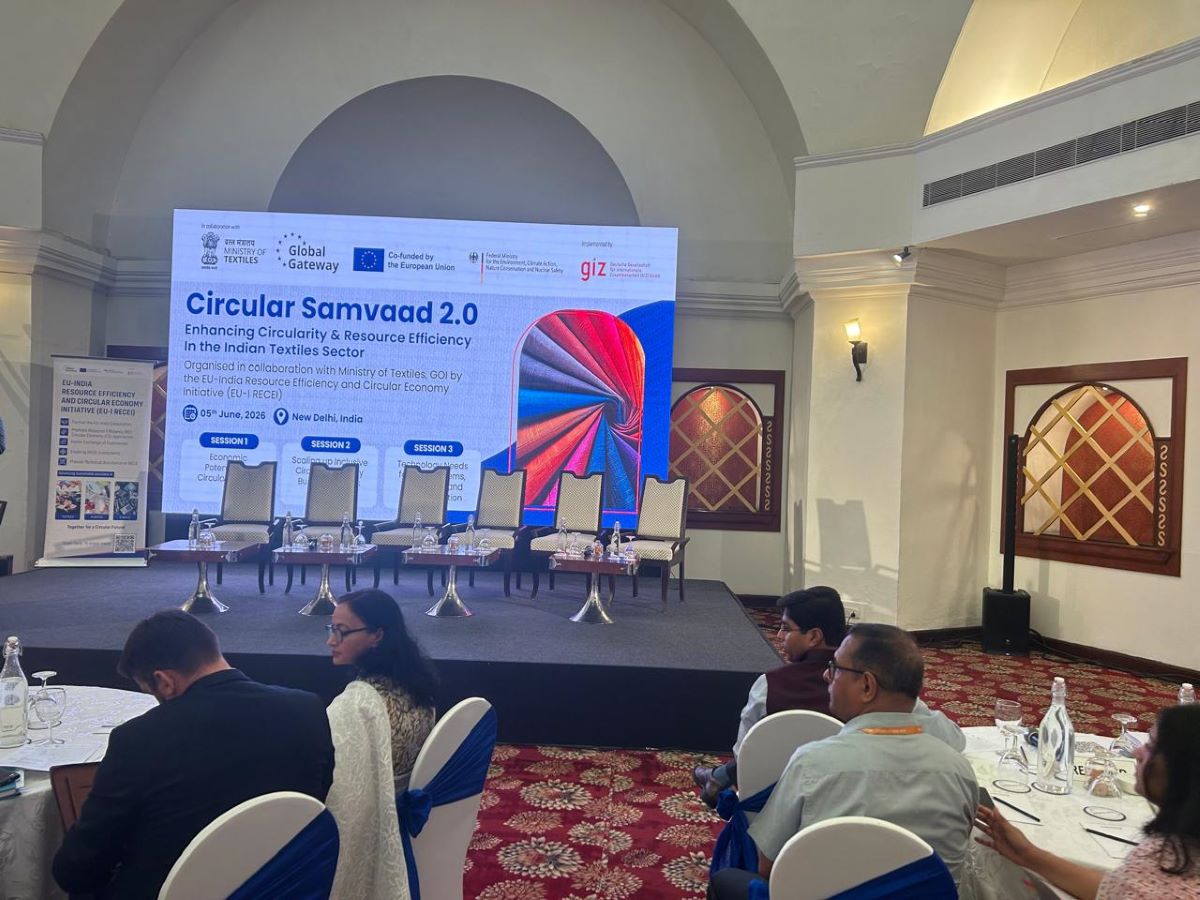
The textile and apparel sector is a critical pillar of India’s economy, contributing significantly to employment generation, industrial output, and exports. At the same time, the sector is characterised by high material intensity and increasing volumes of pre- and post-consumer textile waste, posing challenges related to resource efficiency, waste management, environmental sustainability, and social inclusion. In view of India’s commitments towards sustainable development, climate action, and responsible consumption and production, there is a growing need to adopt circular economy approaches within the textile sector. The India – EU Free Trade Agreement 2026 after ratification, will open new market opportunities for Indian businesses with reduced trade barriers. In this context, a National Study on Fostering Circular Economy in the Indian Textile Sector is being undertaken with the objective of identifying the economic potential of circularity for the textile sector and pathways for transitioning towards enhanced competitiveness.
The textile and apparel sector is a critical pillar of India’s economy, contributing significantly to employment generation, industrial output, and exports. At the same time, the sector is characterised by high material intensity and increasing volumes of pre- and post-consumer textile waste, posing challenges related to resource efficiency, waste management, environmental sustainability, and social inclusion. In view of India’s commitments towards sustainable development, climate action, and responsible consumption and production, there is a growing need to adopt circular economy approaches within the textile sector. The India – EU Free Trade Agreement 2026 after ratification, will open new market opportunities for Indian businesses with reduced trade barriers. In this context, a National Study on Fostering Circular Economy in the Indian Textile Sector is being undertaken with the objective of identifying the economic potential of circularity for the textile sector and pathways for transitioning towards enhanced competitiveness.
The study focuses on assessing the status of textile circularity in India, estimating the economic and employment potential of textile recycling and reuse, analysing trends such as repair, upcycling and conscious consumption, documenting best practices across regions and stakeholder groups, and integrating the circular skills needed for the same. The study also examines policy, regulatory and institutional gaps, with a view to developing actionable recommendations to support the formulation of an enabling policy and implementation framework for circular textiles. It seeks to support the national priorities on resource efficiency, waste reduction, extended producer responsibility, MSME competitiveness, and inclusive growth. The study will also be aligned with emerging national priorities and schemes of the Ministry of Textiles, particularly the Textile Expansion and Employment (TEEM) Scheme and the Tex Eco Initiative. The study is being undertaken under the EU-India Resource Efficiency and Circular Economy Initiative (EU-I RECEI) which is funded by the European Union (EU) and the German Federal Ministry for the Environment, Climate Action, Nature Conservation and Nuclear Safety (BMUKN)), and is jointly implemented with the Ministry of Environment, Forest and Climate Change (MoEFCC), Government of India. The project is implemented by GIZ India in close collaboration with the MoEFCC and sectoral ministry- Ministry of Textiles (MoT), Government of India.
Credits: EU I RECEI Circular Sanvaad 2.0


 CONTACT US
