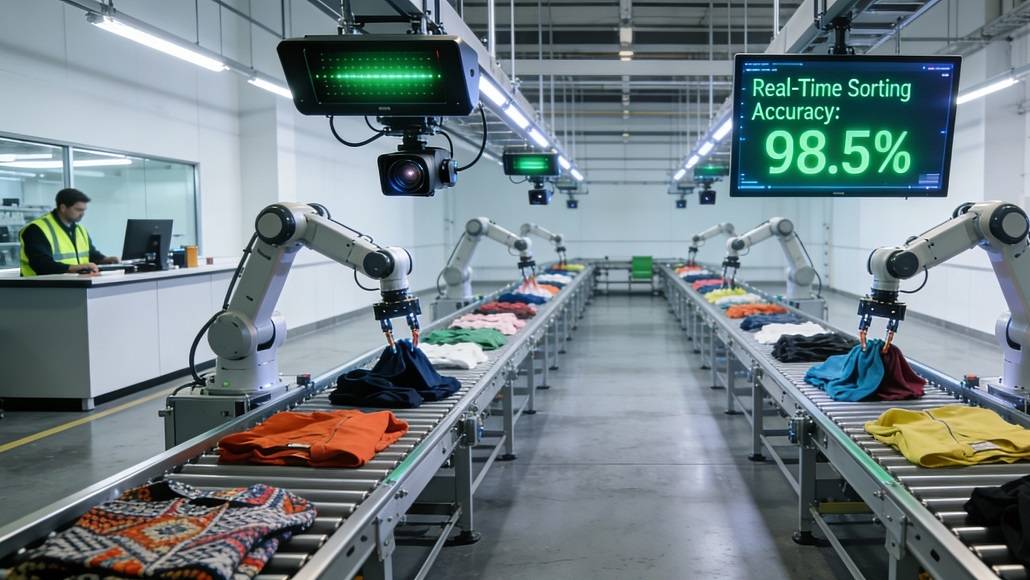
Clothing, one of the most fundamental needs of human beings has a history spanning several thousand years. Over time, the textiles and clothing industry has undergone significant technological transformations. Today, Artificial Intelligence (AI) and Automation are revolutionising textile manufacturing by improving productivity, enabling production of high-value products with consistent quality, reducing manual intervention & waste and facilitating predictive maintenance.
The journey of the textiles and clothing industry has witnessed four major phases of transformation from the ancient cottage industry to the mechanised industry, followed by the automated industry, and now progressing towards Industry 4.0, which integrates AI, the Internet of Things (IoT) and data analytics.
Know More
AI-driven technologies are enabling real-time defect detection to ensure consistent product quality. By analysing machine data, AI can predict potential failures and prevent machine breakdowns through predictive maintenance. It also optimises material utilisation, reduces environmental impact, predicts fashion trends and enables personalised, digitally driven design solutions.
Recognising the importance of creating awareness and equipping entrepreneurs and technocrats with the latest advancements in automation, AI and digital transformation, the Southern India Mills’ Association (SIMA) has conceived the AiTex Summit. The maiden edition of the summit was launched immediately after the inauguration of SIMA Texfair 2026, the International Exhibition on Textile Machinery, Spares and Accessories, held on 6 th March 2026 at Coimbatore.
In his welcome address, SIMA Chairman Durai Palanisamy highlighted that the SIMA AiTex Summit showcases successfully implemented automation solutions that help textile mills enhance productivity, reduce production costs and improve operational efficiency across the value chain. By leveraging AI, ERP integration, intelligent data extraction and real-time analytics, these initiatives transform manual, experience-driven processes into structured, data-driven systems, delivering improved quality control, stronger compliance, optimised resource utilisation and a better overall experience for stakeholders across procurement, production, finance and management.
The summit was inaugurated by Ashwin Chandran, Chairman of the Confederation of Indian Textile Industry (CITI), the Apex body representing the Indian textiles and clothing sector. In his address, the CITI Chairman emphasised the urgent need for the textile industry to adopt AI-driven technologies to remain globally competitive, enhance productivity and ensure sustainable growth.
The expert sessions at the summit covered several key topics, including Leveraging Data and AI Technology for Overall Excellence, LMW e-Spares ERP Integration and Tracker, centralised ERP-integrated tool that captures forex exposures and maps them against hedge contracts to provide real-time visibility and improved financial risk management. Other sessions focused on Digital and Operational Automation in Textile Mills with EXIM Automation and Trade Compliance, Cotton Testing through HVI and AFIS Data Integration, Dispatch Entry Automation, and practical success stories on transforming spinning production from data to decision-making.
The summit underscored the growing need for widespread adoption of AI and
digital technologies in the textile industry to enhance efficiency, strengthen
competitiveness and build a resilient and future-ready manufacturing ecosystem.
CREDITS: Text taken directly from SIMA official PR. The content has not been edited and reviewed by us.


 CONTACT US
