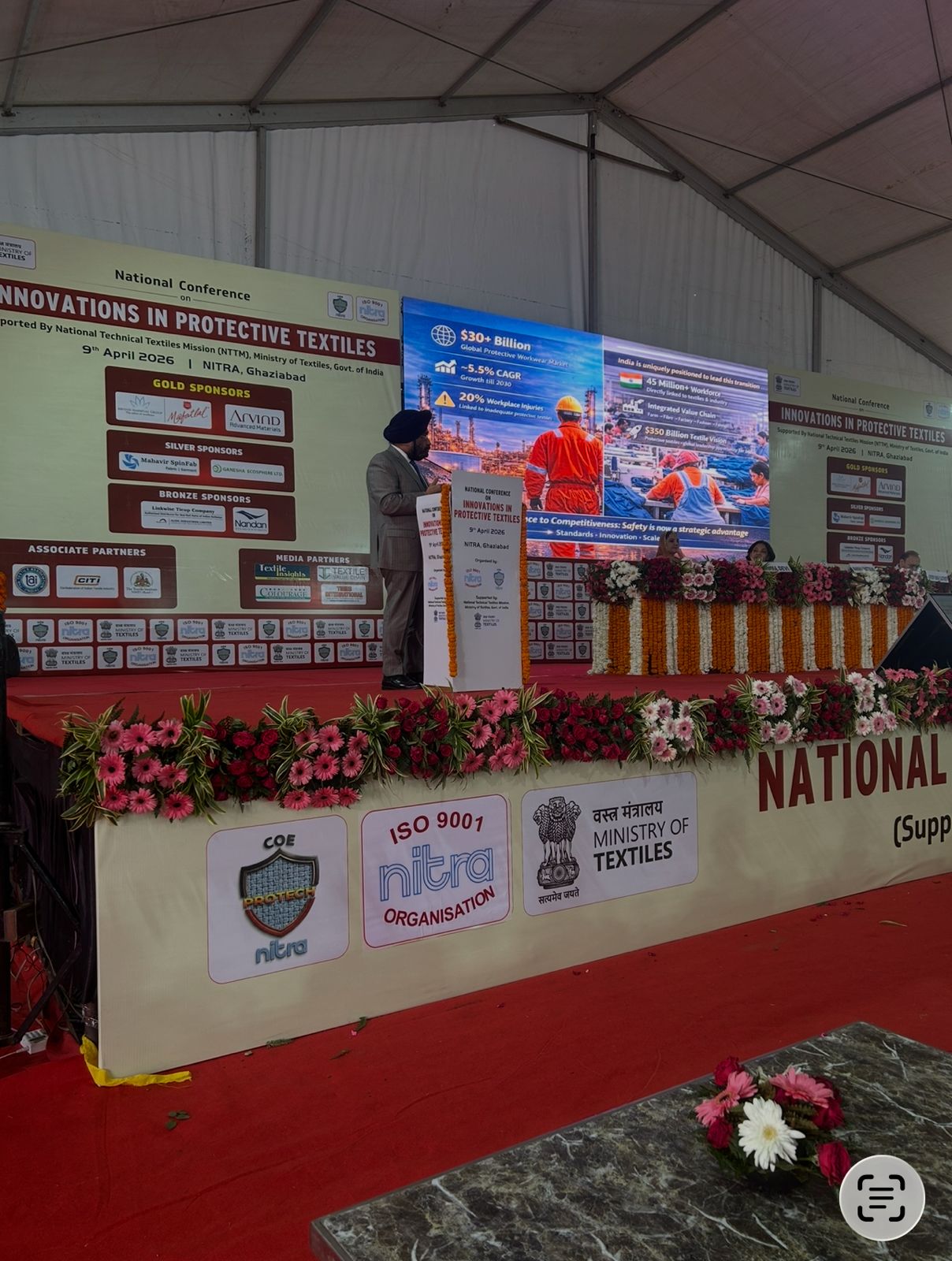
Updeep Singh Chatrath, CEO (Odisha Projects) & Resident Director – Delhi, Welspun World, addressed the NITRA Protective Textile One‑Day Conference on Apl, 2026. The key excerpts are as follows:
“In India we stand at the intersection of challenge and responsibility. In this story of India, I must point out that there are 4.5 crore people working in the textile industry. We have an integrated value chain—from fibre right through to garment. And we have a national ambition of a 350‑billion‑dollar textile economy, out of which 100 billion is targeted for exports. In many ways, we have everything.
But we must also honestly acknowledge that India still does not hold a leadership position in protective textiles on the global stage. We must accept that. Yet, there is a clear opportunity to change it. From this morning’s sessions we heard from the Minister, we heard from Mr. Rajiv, and the message is consistent: there is an opportunity for us.
Now the question is: how do we take that opportunity forward? First, we must recognise that the demand for protective textiles is real—and it is accelerating. This deep transition is opening up new avenues, but it is also creating new hazards. Global infrastructure investment is surging, defence modernisation is reshaping posture across the world, and we can all see how defence capabilities are evolving. Today, every one of these sectors needs protective solutions. And it is not enough for products to merely ‘perform on paper’; some products technically comply but do not protect in practice.
For too long, protective textiles have been treated as a compliance requirement, a cost, and a checklist item. A box to tick in the factory: ‘Yes, we have protective textiles.’ But that era is over. The world is now moving decisively toward a zero‑harm work environment. If you visit any leading‑group factory today, the first item the chairman reviews is accidents and safety. He starts the meeting with that. This is the level of awareness that already exists in the Indian industry.
Standards have become stricter for both the government and our customers. Traceability and sustainability are no longer premium features; they are now baseline expectations. In this world, safety is not a compliance exercise. Safety is a source of competitiveness. The countries that will lead the future will not simply manufacture garments. They will define standards. They will set the benchmarks. And, most importantly, they will be trusted. Trust in protective textiles is the single most important factor.
Trust is the ultimate competitive advantage. It cannot be imported. It cannot be built overnight. It cannot be simply ‘earned’; it has to be earned—product by product, delivery by delivery, year after year. Our strength therefore cannot remain cost alone. We always talk about cost, but our strength cannot remain only on cost. From cost to credibility—that is the journey India must now take.
If India is to lead, we must act with intent across three pillars.
Madam, the first pillar is standards. We must move from fragmented, check‑box compliance to globally benchmarked systems. Quality must be designed into the process, deeply embedded in the system, and verified through institutions that the world recognises. Trust begins with trust in systems—that is the first pillar.
The second pillar is innovation. Protective textiles are ingenious solutions—fire‑resistant, chemical‑resistant, arc‑resistant, and more. Today, these materials must protect not only the worker but also the planet. As Rajiv very clearly showed in his excellent presentation on sustainability, these products must be planet‑positive. Sustainability is no longer a differentiator; it is a threshold requirement. India must lead this engineering frontier, not just follow it.
The third pillar is reliable scale. The question is no longer can you produce? The question is can the world depend on you? We have talked a lot about protective textiles this morning, but what we really need is scale. And not just scale, but consistency and reliability. Reliable scale is what separates a supplier from a leader, a follower from a leader.
To unlock these three pillars—to translate these three priorities into reality—we need urgency and alignment on three fronts.
Madam, the first is fibre leadership in high‑performance fibres. Aramids, specialty synthetic fibres, advanced blends—these are the raw materials of trust. Without fibre leadership, there is no product leadership at all. That is what the Director General pointed out: we first need fibre. Only once we have fibre leadership can we move to true product leadership. This is non‑negotiable. It is foundational.
The second is global certification credibility. We need robust testing and certification infrastructure that is trusted not only in India but worldwide. This morning, when I arrived at NITRA, I was pleasantly surprised to learn that we now have a facility here that tests flame‑retardant fabrics at temperatures of almost 500 degrees. Facilities like this are exactly the credibility India must build. It is here that the role of government, institutions, and a framework for global recognition must come together within India.
The third is ecosystem strength. Technical textiles need to develop alongside skilling and, most importantly, MSME integration. That is the most critical ingredient for technical textiles to grow. Unless we deeply integrate MSMEs, it will be difficult for us to reach a global leadership position. We need a system that compounds capability over time and brings the entire industry—large players and small alike—into a coherent value chain.
Madam, these are not a checklist of tasks. These are strategic investments—in India’s global credibility in safety and performance. With the right policy architecture, India can build this capability within one decade.
Protective textiles are not just products. They are a promise. Let me repeat that: protective textiles are not just products; they are a promise. They are the promise we make to the worker who enters a refinery at six o’clock in the morning. To the woman in a chemical facility who trusts that what she wears will bring her back safely in the evening. To the worker on a construction site, thirty or forty floors above the ground. These are real lives that depend on what we produce.
So when we speak of a 30‑billion‑dollar opportunity in protective textiles, let me leave you with one simple frame that captures this journey.
It is not a market. It is a mandate. A mandate from compliance to competitiveness. From cost to credibility. From merely manufacturing to leadership. The future will not be defined by who produces the most. It will be defined by who is trusted the most.
And I firmly believe that, in protective textiles, India is not just manufacturing products. India is manufacturing trust in safety. And the world is waiting for us to step forward.”


 CONTACT US
