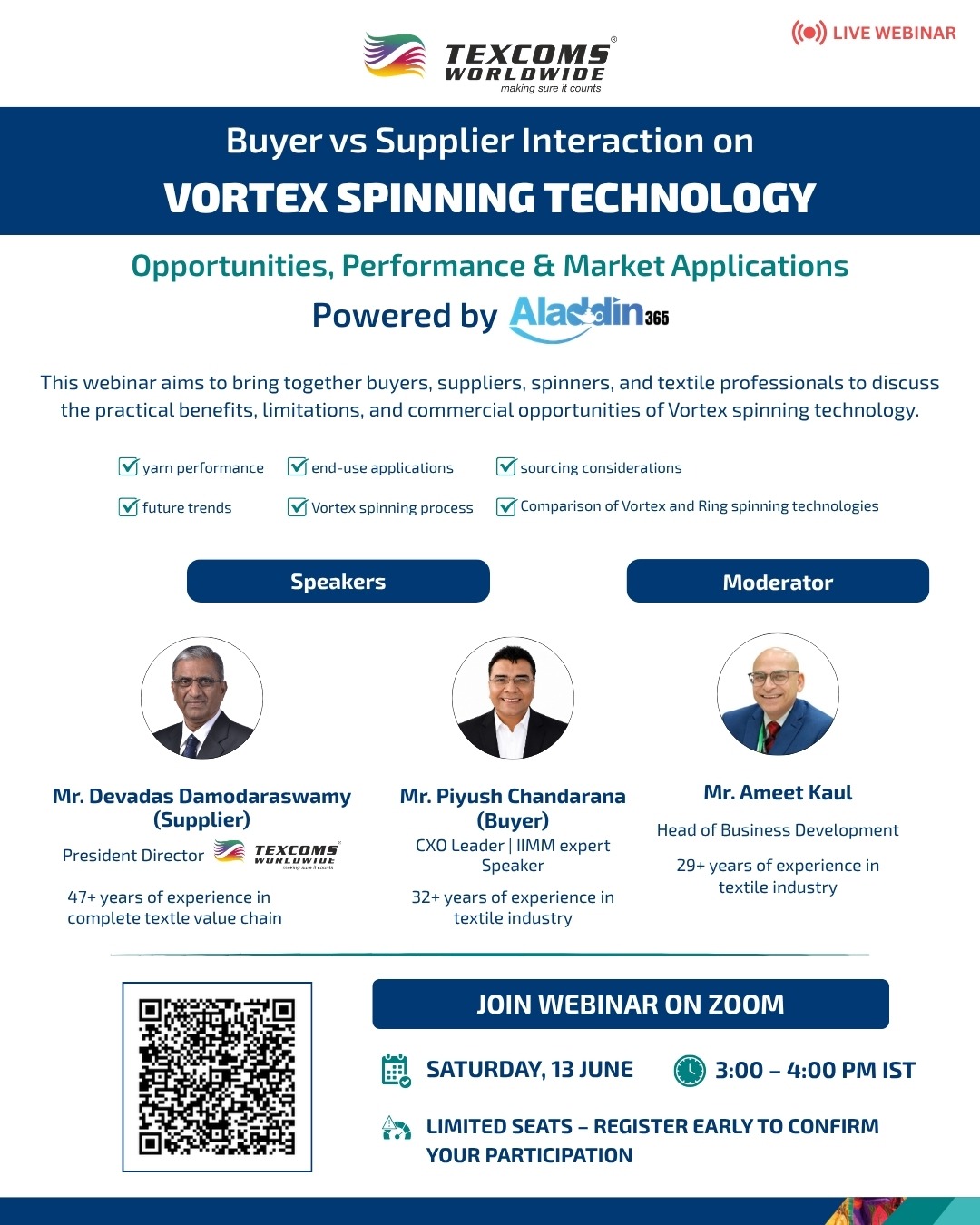
Buyer vs Supplier Perspectives on Vortex Spinning Technology
The Texcoms Worldwide webinar brought together two seasoned voices of the textile industry: Mr. Piyush Chandarana, representing buyers, and Mr. Devadas Damodaraswamy, representing suppliers. Their dialogue highlighted how Vortex Spinning is reshaping textile production, performance, and sustainability.
From the buyer’s lens, Chandarana emphasized that global apparel buyers demand better quality, higher productivity, greater sustainability, and improved profitability. With China investing aggressively in vortex technology, buyers are keen to understand whether it truly delivers beyond technical novelty. Key questions revolve around whether vortex yarns reduce pilling, lint, and customer complaints, while also offering cost and productivity benefits. Buyers want clarity on which fibres and blends are best suited, and whether vortex can address labour shortages and sustainability challenges.
On the supplier side, Damodaraswamy underscored the disruptive potential of vortex spinning. He provocatively suggested that ring frames may soon belong in museums, given their labour intensity and space requirements. By combining the roles of simplex, ring frame, and auto coner into one fully automatic machine, vortex spinning offers lower costs, reduced labour dependency, and consistent quality. Delivering yarn at speeds up to 550 m/min, vortex technology saves 30% energy per kilogram of yarn and produces fabrics with ring‑like geometry but superior performance.
The technical comparisons presented were striking. Vortex yarns exhibit lowest hairiness, high pilling resistance, low lint shedding, and durable garment performance. Fabrics show reduced shrinkage, low spirality, and superior moisture wicking. Dye uptake is stronger, enabling cost savings in dyeing operations. Economically, vortex yarns reduce garment rejection rates from 1.4% to 0.12%, translating into significant savings for manufacturers.
Beyond performance, vortex spinning is recognized as a green technology, with lower power consumption, reduced building space, and eligibility for carbon credits. With over 2.6 million vortex positions installed globally, and new entrants like Savio, Saurer, and LMW joining Murata and Rieter, the technology is poised for mass adoption.
In essence, vortex spinning bridges buyer expectations and supplier innovation, offering a pathway to sustainable, profitable, and high‑performance textiles.
CREDITS: Source-PPT received from Support Aladdin <


 CONTACT US
